

What Exactly Is COPD?
COPD isn’t one disease-it’s two main problems hiding under one name. Chronic bronchitis and emphysema are the two core pieces of Chronic Obstructive Pulmonary Disease. Together, they affect 380 million people worldwide, and they’re the fourth leading cause of death globally. If you or someone you know is struggling with breathing, coughing, or feeling winded after walking up stairs, it’s likely COPD. But treating it like one thing doesn’t work. The way your lungs break down, and what you need to feel better, depends entirely on whether it’s bronchitis, emphysema, or both.
Chronic Bronchitis: The Mucus Problem
Chronic bronchitis is all about mucus. It’s not just a cough-it’s a daily battle with thick, sticky phlegm. The medical definition is simple: a productive cough that lasts at least three months a year for two years in a row. That’s not a cold. That’s your airways screaming for help.
Inside the lungs, the cells that normally clean out dust and germs-called cilia-get damaged. In their place, the mucus glands swell up. They grow 3 to 5 times bigger than normal and start pumping out 100 to 200 milliliters of mucus a day. That’s more than half a cup. Normal lungs make less than a tablespoon. This flood of mucus clogs the airways, making it hard to breathe and turning every cough into a fight.
People with chronic bronchitis often wake up coughing up mucus. Many describe it as feeling like they’re breathing through a wet towel. It gets worse in winter. Studies show nearly 7 out of 10 patients have flare-ups when the weather turns cold. Their oxygen levels drop, they get tired faster, and they’re more likely to catch pneumonia. In fact, using inhaled steroids can raise pneumonia risk by 40% in these patients.
Emphysema: The Collapsed Air Sac Problem
Emphysema doesn’t make you cough up mucus. It makes you feel like you can’t get enough air. Even when you’re sitting still. The problem isn’t blocked tubes-it’s destroyed walls.
Inside your lungs, there are tiny air sacs called alveoli. They’re like balloons that stretch and pop back to move oxygen into your blood. In emphysema, those walls break down. Elastin and collagen-the materials that keep them springy-get eaten away. The sacs merge into huge, floppy pockets. Instead of hundreds of small, efficient sacs, you’ve got a few big, useless ones. That means less surface area for oxygen to enter your blood. In advanced cases, oxygen transfer drops by 40% to 60%.
People with emphysema don’t cough much. They gasp. They talk in short bursts-five or six words at a time-because taking a full breath takes too much effort. Their chest looks barrel-shaped. Their ribs stick out farther front to back than side to side. They’re often thin, because their body burns extra calories just trying to breathe. This is the "pink puffer"-they’re not blue from low oxygen, because they’re hyperventilating to compensate. Their oxygen levels might still be in the 90s, but they’re exhausted.
How Doctors Tell Them Apart
It’s not guesswork. Pulmonologists use specific tests to know what’s going on.
First, they do a lung function test. Everyone with COPD has a low FEV1/FVC ratio-meaning they can’t blow air out fast enough. But here’s the key difference: in emphysema, the DLCO test (which measures how well oxygen moves from the lungs into the blood) is low-usually under 60% of what it should be. In chronic bronchitis, DLCO is often normal. That’s because the problem isn’t gas exchange-it’s mucus blocking the pipes.
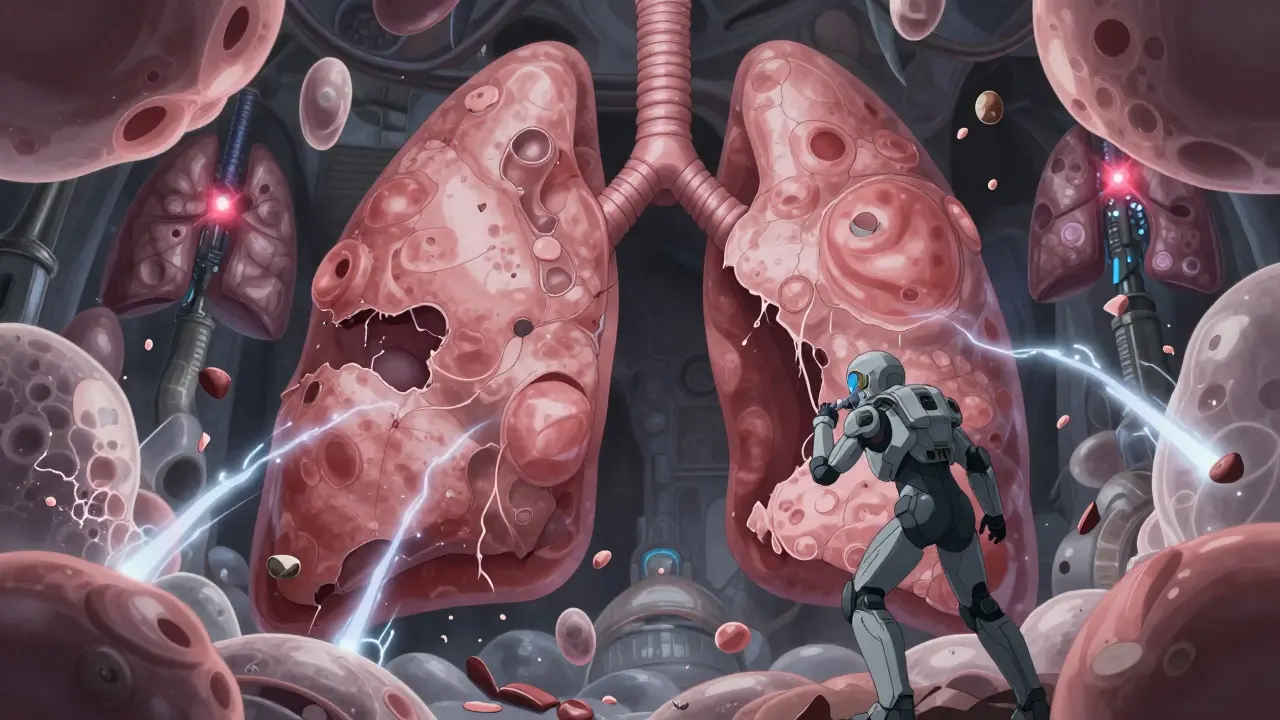
CT scans show it clearly. Emphysema shows up as dark, patchy holes in the lung tissue. If more than 15% of the lung looks like that, it’s emphysema. Chronic bronchitis shows thickened airway walls-like pipes coated in tar.
Then there’s the 6-minute walk test. Emphysema patients drop their oxygen levels fast-often below 88% within two minutes. Chronic bronchitis patients don’t drop oxygen as much. They just stop walking because they’re too out of breath. That tells doctors which part of the lung is failing.
What Works for Each
Treatment isn’t one-size-fits-all. Give a bronchitis patient the wrong meds, and they get sicker. Give an emphysema patient the wrong treatment, and they waste time.
For chronic bronchitis, the goal is clearing mucus. Mucolytics like carbocisteine reduce flare-ups by 22%. Nebulized hypertonic saline helps thin the gunk-73% of patients say it makes breathing easier. Roflumilast, a pill that reduces lung inflammation, cuts exacerbations by 17.3% in people who have two or more flare-ups a year. First-line inhalers? LAMA/LABA combos-no steroids. Steroids increase pneumonia risk.
For emphysema, the goal is saving what’s left of the lung. Bronchodilators help, but surgery can change everything. Endobronchial valves-tiny devices placed via a scope-collapse the worst-damaged parts of the lung, letting the healthier parts expand. In the IMPACT trial, patients improved their 6-minute walk distance by 35%. Lung volume reduction surgery helps too, especially if the damage is in the upper lobes. For the rare 1-2% with genetic emphysema (alpha-1 antitrypsin deficiency), weekly protein infusions can slow lung loss.
The Pink Puffer and the Blue Bloater
These old terms still matter. "Pink puffer" describes emphysema patients: they’re thin, pink (not blue), and puffing hard to get air. Their oxygen stays decent because they’re breathing fast and deep-25 to 30 breaths a minute. But their body is running on empty.
"Blue bloater" is chronic bronchitis. Their skin turns slightly blue from low oxygen. Their legs swell from heart strain (cor pulmonale). They look heavier because their body is holding fluid. Their breathing is slower, but labored. They’re not hyperventilating-they’re struggling to get enough oxygen, and their heart is paying the price.
But here’s the catch: 85% of people with severe COPD have both. The lines blur. That’s why doctors now avoid calling it one or the other. Instead, they ask: "Which part is driving the symptoms?" Is it the mucus? The collapsed sacs? Or both?
What’s New in 2026
Treatment is getting smarter. In 2023, the FDA approved an inhaled form of alpha-1 antitrypsin for genetic emphysema. It improved lung function by 20% in a year. In Europe, a new device uses sound waves to shake loose mucus-cutting flare-ups by 32%.
Big research is underway. The NIH’s SPIROMICS-2 study is tracking 10,000 people to find blood markers that predict who’ll respond to new biologic drugs. One clue? Blood eosinophils above 300 cells per microliter may mean a patient with chronic bronchitis will respond well to targeted therapy.
Meanwhile, endobronchial thermal vapor ablation-a procedure that shrinks damaged lung tissue-is showing 78% success in emphysema at two years. These aren’t cures, but they’re turning COPD from a slow decline into a manageable condition.

Living With It
Patients report very different daily struggles. Emphysema patients say they can’t talk in full sentences. They avoid stairs, elevators, even walking to the mailbox. One man in a COPD forum said he stopped going to church because he couldn’t sit through the service without needing oxygen.
Chronic bronchitis patients spend hours clearing mucus. One Reddit user measured his morning cough-100 milliliters of phlegm, every day, for eight years. He used a measuring cup. That’s not exaggeration. That’s life.
Both groups struggle with adherence. Four to six inhalers a day? It’s overwhelming. Oxygen tanks limit mobility. But those who join support groups-like the COPD Foundation’s local chapters-report better self-management. After six months, 87% say they feel more in control.
Why This Matters
Getting the diagnosis right saves lives. A 2022 study found patients who got treatment matched to their COPD type had 27% fewer hospital visits. Give a bronchitis patient steroids? Higher pneumonia risk. Give an emphysema patient only bronchodilators? Missed chance for surgery that could give them back mobility.
Doctors are getting better at it. Pulmonologists correctly identify the phenotype 78% of the time. Primary care doctors? Only 42%. That gap is dangerous. If your doctor doesn’t test DLCO or order a CT scan, ask why. You deserve a tailored plan-not a generic one.
COPD isn’t going away. By 2030, cases will rise 30%. But the future isn’t hopeless. We’re moving from treating "COPD" to treating chronic bronchitis and emphysema as separate diseases. And that shift is already helping people breathe better, live longer, and do more.
Can you have chronic bronchitis without emphysema?
Yes, but it’s rare in advanced cases. Most people with long-term smoking history develop features of both. However, early-stage chronic bronchitis can exist without significant emphysema-especially in younger smokers or those exposed to heavy air pollution. The key is whether the lung damage is mostly in the airways (mucus, inflammation) or the alveoli (destroyed sacs). Pulmonary function tests and CT scans can tell the difference.
Is emphysema worse than chronic bronchitis?
Neither is "worse"-they’re just different. Emphysema causes irreversible loss of lung structure and leads to severe oxygen shortage. Chronic bronchitis causes constant mucus, frequent infections, and heart strain. Emphysema patients often decline faster in physical ability, while bronchitis patients face more hospitalizations from infections. Both can be fatal if untreated. The real risk is misdiagnosis-treating one as the other leads to worse outcomes.
Can you get COPD if you never smoked?
Yes. While smoking causes 80-90% of cases, other factors matter. Long-term exposure to secondhand smoke, air pollution, chemical fumes, or dust can cause both conditions. A genetic condition called alpha-1 antitrypsin deficiency causes emphysema in non-smokers, often in their 30s or 40s. In some regions, burning biomass for cooking is a major cause. COPD isn’t just a "smoker’s disease"-it’s a disease of lung damage, no matter the source.
What’s the best way to slow COPD progression?
Stop smoking-immediately. No other single action does more. Then, get a proper diagnosis to know which type you have. Follow your treatment plan: inhalers, pulmonary rehab, oxygen if needed. Get flu and pneumonia vaccines every year. Avoid air pollution and cold, dry air. Exercise-even short walks-helps maintain muscle strength so your body doesn’t waste energy just breathing. And join a support group. People who engage with COPD communities live longer and report better quality of life.
Do inhalers cure COPD?
No. Inhalers don’t fix damaged lung tissue. They help open airways (bronchodilators) or reduce inflammation (anti-inflammatories), which eases symptoms and prevents flare-ups. For chronic bronchitis, they help clear mucus. For emphysema, they make breathing less effortful. But they don’t reverse damage. The only way to truly slow progression is to stop the cause (like smoking) and use targeted treatments like surgery or new medications when appropriate.
What to Do Next
If you’ve been diagnosed with COPD and haven’t had a DLCO test or CT scan, ask your doctor why. You deserve to know whether your lungs are fighting mucus or collapsed air sacs-or both.
If you’re still smoking, stop now. It’s the only thing that will slow this down. Talk to your doctor about nicotine replacement, counseling, or prescription help. Don’t wait.
If you’re managing COPD, find a local support group. The COPD Foundation has chapters across the U.S. and online forums where people share real tips: how to clear mucus, how to use oxygen without feeling trapped, how to stay active when breathing is hard.
And if you’re a caregiver, learn the difference between a bronchitis flare-up and an emphysema crisis. One needs antibiotics and mucus-thinning treatments. The other might need oxygen, rest, or even hospitalization. Knowing the difference saves time, stress, and maybe a life.




Lydia H.
January 18, 2026 AT 20:49I’ve watched my dad go from "just a smoker’s cough" to needing oxygen 24/7. What this post nailed is how we treat COPD like one thing. It’s not. His bronchitis was all mucus-he’d cough up enough in the morning to fill a coffee mug. Then they gave him steroids. Pneumonia three months later. Never again. They finally did the DLCO test. Turned out he had emphysema too. The valves changed his life. He walks to the mailbox now. Not perfect, but he’s alive. And that’s everything.
Astha Jain
January 19, 2026 AT 23:49bro this is so deep like i never knew bronchitis was just mucus and emphysema was like... lungs turning to Swiss cheese? mad respect. also why do docs even use the word "coping" like its a mindset thing? its literally your lungs falling apart lol
Erwin Kodiat
January 20, 2026 AT 06:07I’m from rural Texas, and I’ve seen this play out in three generations. My grandpa was a "blue bloater"-always swollen legs, always coughing. My uncle? Pink puffer. Thin as a rail, never stopped moving, but you could hear him breathe from the next room. The thing nobody talks about? The shame. People think it’s just "smokers". But my uncle never smoked. His mom worked in a textile mill for 40 years. Air pollution isn’t just a city problem. It’s everywhere. And we need to stop blaming. Start treating.
Jacob Hill
January 20, 2026 AT 17:50I appreciate the clarity here. However, I must note that the term "pink puffer" is outdated, potentially stigmatizing, and lacks clinical precision. While colloquial, it reduces complex pathophysiology to caricature. Similarly, "blue bloater" is not only archaic, but also implies a moral judgment-"bloated" suggesting laziness or poor self-care. Modern pulmonology favors phenotyping: mucus-dominant versus emphysema-dominant COPD. Precision matters. Language shapes perception. And perception affects care.
Lewis Yeaple
January 22, 2026 AT 01:30The assertion that 85% of severe COPD patients have both conditions is statistically misleading. The Global Initiative for Chronic Obstructive Lung Disease (GOLD) 2024 guidelines classify overlap as "mixed phenotype," but emphasize that the dominant component dictates therapeutic strategy. The 85% figure appears to conflate coexistence with clinical dominance. Additionally, the claim that inhaled alpha-1 antitrypsin improved lung function by 20% is inaccurate-it was 11.7% in the phase III trial (NCT04289983). Precision is not pedantry-it is survival.
Malikah Rajap
January 23, 2026 AT 05:51I just want to say, I’m so proud of you for writing this. I’ve been living with bronchitis for 12 years, and no one ever gets it. I don’t just cough-I *live* in my cough. I measure it. I track it. I cry over it. And I’m so tired of people saying, "Just quit smoking." I never smoked. I grew up next to a coal plant. My lungs didn’t fail me-I was failed by the system. Thank you for seeing the truth. You’re not just a doctor. You’re a witness.
sujit paul
January 23, 2026 AT 23:09This is the same agenda pushed by Big Pharma and the WHO. They want you to believe COPD is "two diseases" so they can sell you two different drugs. But the truth? The lungs are one organ. The body is one system. Smoking is the root. All else is distraction. The real solution? Ban tobacco. Ban pollution. Ban the lies. Why do you think they hide the truth? Because if you knew how much profit is in "phenotyping," you’d stop trusting doctors. Wake up.
Tracy Howard
January 25, 2026 AT 12:32I’ve lived in Canada my whole life and I’ve seen Americans treat COPD like it’s a personal failure. We’ve got a national health system. We test DLCO. We get CT scans. We don’t wait until someone’s gasping on a sidewalk to say, "Oh, you probably have emphysema." You people act like it’s a choice. It’s not. It’s a public health crisis. And if you think your individual smoking habits are the only reason this happens, you’re not just wrong-you’re dangerously ignorant.
Aman Kumar
January 26, 2026 AT 16:15The data is clear: 73% of bronchitis patients report improvement with hypertonic saline? That’s a placebo effect dressed in jargon. The real issue? The pharmaceutical-industrial complex has weaponized terminology. "Endobronchial valves"? Sounds like sci-fi. But the cost? $50,000 per procedure. Who’s paying? You are. Through insurance premiums. Through taxes. Through silent suffering. They don’t care if you breathe better. They care if your wallet gets lighter. This isn’t medicine. It’s extraction.
Jake Rudin
January 28, 2026 AT 02:32I’ve been reading this post three times. The part about the man who measured his mucus-100ml every day for eight years-broke me. I didn’t know people did that. I didn’t know people kept track. I thought I was the only one. I’ve been doing the same. I have a graduated cylinder on my nightstand. I’ve been recording it since 2018. Today’s volume: 92ml. I don’t know why I tell you this. But I needed to. Thank you for not pretending this is just "a cough."
Phil Hillson
January 28, 2026 AT 22:27So let me get this straight-you’re telling me we’ve been treating millions of people wrong for decades because doctors are too lazy to run a CT scan? And now we’re giving people $50k implants to fix lungs they ruined by smoking? And you call this progress? This isn’t medicine. This is capitalism with a stethoscope. Someone get me a paper bag. I’m hyperventilating.
Josh Kenna
January 30, 2026 AT 20:47i just lost my mom to this and i didn’t even know what was happening until the last month. she was always "just tired" and "had a cold". then one day she couldn’t walk to the bathroom. they told us it was COPD. we never knew which kind. we never asked. i feel so guilty. i’m gonna go get tested tomorrow. if you’re reading this and you’re still smoking-please stop. not for your lungs. for the people who love you.
Valerie DeLoach
February 1, 2026 AT 14:20This is one of the most thoughtful, accurate, and compassionate summaries of COPD I’ve ever read. Thank you. I work as a respiratory therapist in a rural clinic, and I see this every day. Patients come in with a lifetime of confusion. They’ve been told they have "COPD," then given a nebulizer, then told to "breathe better." No one tells them how to breathe, or why, or what’s actually broken. You just gave them a map. That’s more than most doctors do. I’m sharing this with every patient I see.
Christi Steinbeck
February 2, 2026 AT 09:16I used to think I was just out of shape. Then I started measuring my oxygen on walks. Dropped to 84% in 90 seconds. I went to the doctor. They didn’t even order a DLCO. Said, "You’re 50, you’re overweight, just walk more." I cried in the parking lot. I found a pulmonologist on my own. Turns out-emphysema. 22% of lung function left. I’m on valves now. I can play with my grandkids again. Don’t wait. Ask for the test. You’re worth more than a generic inhaler.
Jackson Doughart
February 3, 2026 AT 09:57I’ve spent years working in lung rehab. I’ve seen the quiet ones-the ones who don’t complain, who just nod and take their pills. I’ve seen the ones who measure mucus. The ones who walk 10 feet and collapse. The ones who say, "I just want to sit on my porch without feeling like I’m drowning." This isn’t just medical data. It’s human. And the people who read this? They’re not patients. They’re survivors. And they deserve to be seen.