
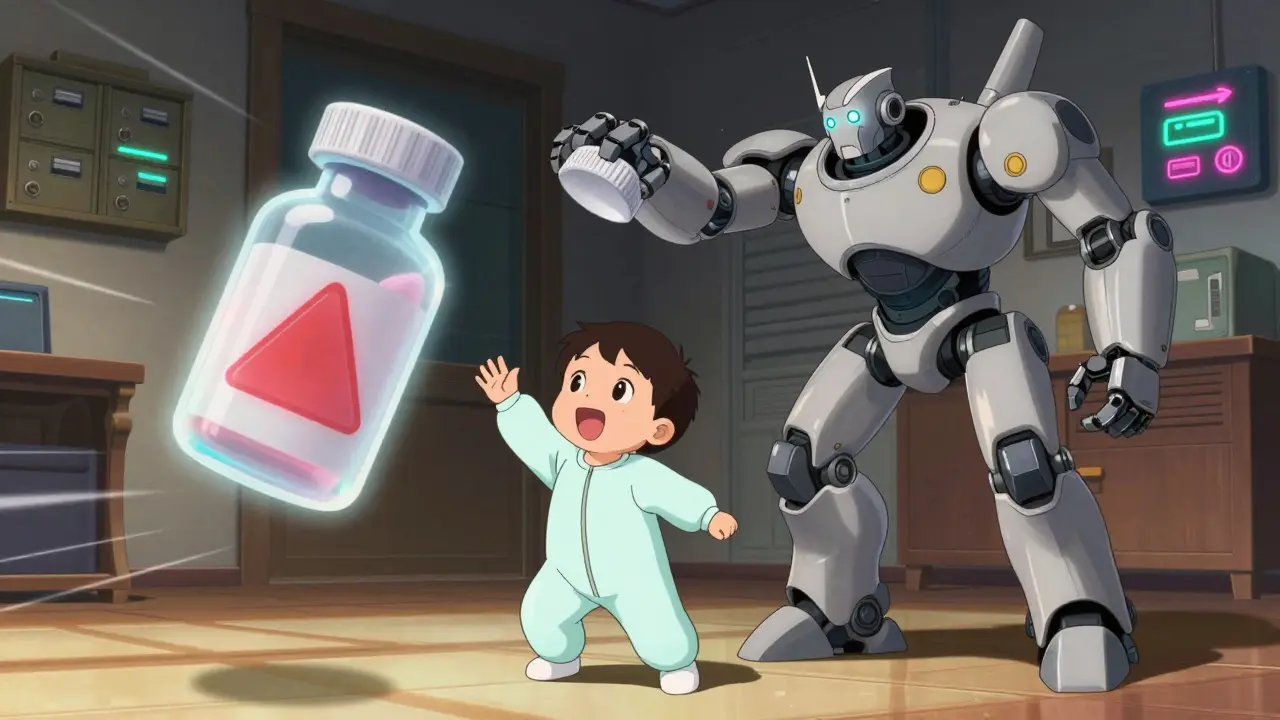
Every year, over 50,000 children under six in the U.S. end up in emergency rooms because they swallowed something they shouldn’t have. Most of these cases aren’t accidents in the traditional sense-they’re exploratory ingestions. These happen when a curious toddler, learning about the world by putting everything in their mouth, grabs a bottle of medicine, a bottle of cleaner, or even a colorful laundry pod. It’s not negligence. It’s development. And that’s why prevention has to be smarter than just saying "keep it out of reach."
Understand the Real Risk: It’s Not About Carelessness
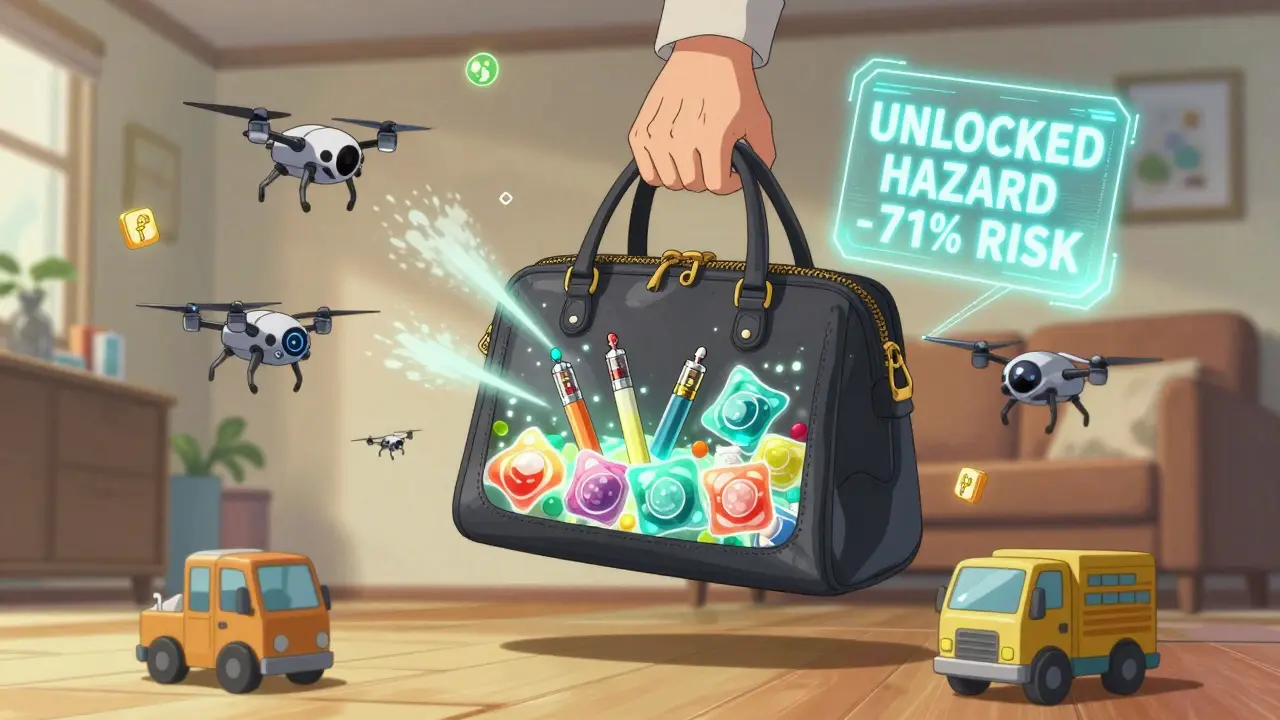
Children between 1 and 4 years old are at the highest risk. Why? Because that’s when they crawl, pull up, walk, and start exploring everything. Their curiosity isn’t dangerous-it’s normal. But their ability to tell the difference between medicine and candy? That doesn’t develop until much later. The American Academy of Pediatrics says 75% of these poisonings happen because kids are just doing what kids do. And here’s the twist: 22% of cases happen when visitors leave handbags or backpacks on the floor. Grandparents, babysitters, even friends-anyone who brings a purse with pills or vape refills inside can unknowingly create a hazard.Lock It Up: Storage That Actually Works
"Out of sight, out of mind" doesn’t cut it. A child can climb, pull, and reach far more than you think. The National Safety Council found that storing all hazardous items in locked cabinets at least 5 feet off the ground stops 82% of access attempts by kids under four. That’s not a suggestion-it’s a baseline.- Medicines (prescription and OTC) go in a locked cabinet, not a drawer.
- Household cleaners, bleach, and disinfectants? Separate from food. Mixing them with snacks or cereal containers causes 37% more confusion-related ingestions.
- Laundry pods, e-cigarette refills, and cannabis edibles? They’re designed to look like candy. Store them in a locked box, not on a shelf.
- Button-cell batteries? One can cause severe internal burns in 15 minutes. Keep them locked and out of sight.
Child-Resistant Isn’t Child-Proof-And You’re Probably Not Using It Right
The Poison Prevention Packaging Act of 1970 made child-resistant caps standard. And yes, they cut aspirin deaths by 45% between 1974 and 1992. But here’s the problem: they’re not foolproof. And most parents don’t use them correctly. A 2022 National Safety Council survey found that while 92% of households have child-resistant caps, only 54% snap them back after every use. For parents of 18- to 24-month-olds? That number drops to 39%. Why? Rushed mornings. Tired hands. The bottle feels hard to open. So you leave it loose.That’s not a mistake-it’s a pattern. And it’s dangerous. Child-resistant caps are designed to slow down a child, not stop them. If you don’t reseal after every use, you’re undoing the safety feature. Always lock it. Even if you’re just stepping into the next room.
Use the Right Tools: No More Kitchen Spoons
Giving a child medicine with a kitchen spoon? That’s like trying to measure a cup of flour with your hand. A 2021 study in Pediatrics showed 76% of parents made dosing errors using spoons, cups, or droppers not meant for medicine. Only 12% made mistakes when they used the dosing device that came with the medicine.Here’s what to do:
- Always use the syringe, cup, or dropper that came with the medication.
- Check the label for the exact dose. Don’t guess.
- Never use a household spoon. Even "teaspoons" vary by brand.
- Teach-back method works: Ask the parent to show you how they’ll give the dose. 82% get it right when they demonstrate, compared to 47% just hearing instructions.
Watch for the Hidden Hazards
Some dangers aren’t obvious. The American Academy of Pediatrics calls out a few:- Laundry pods: Bright colors, sweet smells. They’re still a top cause of poisoning in toddlers, even after industry changes.
- E-cigarette refills: Liquid nicotine looks like candy syrup. Poison control calls for nicotine exposure rose 1,500% between 2012 and 2020. The 2022 Child Nicotine Poisoning Prevention Act now requires unit-dose packaging and warning labels-but not all products comply yet.
- Cannabis edibles: In states where marijuana is legal, these now account for 7% of pediatric poisonings. Hospitalization rates are over three times higher than for other ingestions.
- Buprenorphine: Used for opioid addiction, this drug has seen a 156% increase in child exposures since 2010. It’s not just opioids-it’s a different kind of emergency.
These aren’t rare. They’re rising. And they’re preventable-if you know what to look for.
Engineering Helps: Bittering Agents and Smart Packaging
Some products now include denatonium benzoate-a bitter chemical that makes anything taste awful. It’s added to cleaners, antifreeze, and even e-liquids. Research shows it cuts the chance of multiple swallows by 68%. But here’s the catch: it doesn’t stop a single, fatal dose. It just gives a child time to spit it out.And packaging is evolving. Laundry pods now have double-latch lids. Nicotine refills come in opaque, hard-to-open containers. The World Health Organization is pushing for universal unit-dose packaging for all liquid medications by 2027. That could prevent 15,000 ER visits a year in the U.S. alone.
These aren’t magic fixes. But they’re part of the solution.
Plan for Visitors and Transitions
You’ve got your home locked down. But what about Grandma’s house? Or the babysitter’s? A 2021 study found 71% of parents reported inconsistent safety practices at other caregivers’ homes. That’s where 1 in 5 poisonings happen.Here’s what to do:
- Before a visit, ask caregivers: "Where do you keep your meds?"
- Bring a portable lockbox for your own medications.
- Leave a note: "Medicines are locked in the top cabinet. Do not open."
- Keep a list of emergency numbers in your wallet and leave a copy with caregivers.
Consistency across caregivers isn’t optional. It’s essential.
Know the Emergency Response
Don’t wait. Don’t guess. Don’t try to make your child vomit. Don’t give activated charcoal unless a professional says so. The Society for Academic Emergency Medicine says 78% of positive outcomes happen when help is called within 30 minutes.Keep this number saved in your phone: 1-800-222-1222. That’s Poison Control. They’re available 24/7. They don’t judge. They don’t ask for insurance. They just help.
Also, download the Poison Control app. It’s rated 4.7 stars. 89% of users say they found help within 90 seconds. That’s faster than calling 911 in many areas.
Start Early: Prevention Begins Before Crawling
You don’t wait until your child is walking to baby-proof the house. You start at 9 months-before crawling begins. The American Academy of Pediatrics recommends beginning poison prevention during the 9-month well-child visit. That’s when you get the checklist: cabinet locks, outlet covers, secure storage.It takes about 4.7 hours to fully child-proof a home. That’s not a lot when you consider it might prevent a trip to the ER. Install locks (2.3 hours), cover outlets (1.1 hours), and do a full safety walk-through (1.3 hours). Do it once. Then check every three months. Kids grow fast. New risks appear.
Final Thought: It’s Not About Being Perfect
You’re not going to prevent every single exposure. But you can cut the risk dramatically. Lock it. Use the right tools. Call Poison Control. Teach everyone who cares for your child. And don’t wait until something happens to act.Most parents who’ve had a near-miss say the same thing: "I thought I was being careful." The truth? Being careful isn’t enough. You have to be systematic. Consistent. And ready.
What should I do if my child swallows something poisonous?
Call Poison Control immediately at 1-800-222-1222. Do not wait for symptoms. Do not try to make your child vomit. Do not give activated charcoal unless instructed by a professional. Have the product container ready when you call. The sooner you call, the better the outcome-78% of positive outcomes happen when help is called within 30 minutes.
Are child-resistant caps really effective?
Yes-but only if you use them correctly. Child-resistant caps reduced aspirin deaths by 45% between 1974 and 1992. But they’re designed to slow down a child, not stop them. If you don’t reseal the cap after every use, you’re leaving your child at risk. Studies show only 54% of parents consistently reseal these caps, and that number drops to 39% for parents of toddlers.
Why can’t I use a kitchen spoon to give medicine?
Kitchen spoons vary in size and shape. A 2021 study in Pediatrics found that 76% of parents made dosing errors using household spoons. Only 12% made mistakes when using the dosing device that came with the medicine. Always use the syringe, cup, or dropper provided with the medication. It’s calibrated for accuracy.
What are the most dangerous household items for young children?
The top three are: (1) liquid medications (especially those in sweet-tasting formulas), (2) button-cell batteries (which can burn internal tissue in 15 minutes), and (3) e-cigarette nicotine refills (which look like candy syrup). Laundry pods, cleaning products, and cannabis edibles are also high-risk. All should be stored in locked cabinets at least 5 feet off the ground.
How often should I check my home for poison risks?
Every three months. Children develop new skills quickly-crawling, pulling up, walking-and each milestone opens new access points. The CDC recommends checking your home at child’s-eye level every 3 months. Pay special attention during transitions like 8-10 months (pulling to stand) and 12-15 months (walking).
Can I trust safety practices at my parents’ or babysitter’s house?
No-not without checking. A 2021 study found 71% of parents reported inconsistent safety practices at other caregivers’ homes. Grandparents may store meds on counters. Babysitters may leave purses on the floor. Always ask: "Where do you keep your medicines?" Bring your own portable lockbox. Leave written instructions. Consistency saves lives.
What’s the best tool for quick help during a poisoning emergency?
The Poison Control mobile app. It’s rated 4.7 stars and has helped 89% of users find critical information within 90 seconds. It includes a symptom checker, product database, and direct link to 1-800-222-1222. Save it on your phone. Share it with every caregiver.
Is there a way to make household cleaners safer for kids?
Yes. Many cleaners now contain denatonium benzoate, a bittering agent that makes substances taste awful. Research shows it reduces the chance of multiple swallows by 68%. While it doesn’t stop a single fatal dose, it gives a child time to spit it out. Look for products with this additive. Also, store cleaners in a locked cabinet separate from food.




tia novialiswati
February 22, 2026 AT 17:27Love this post! Seriously, so many parents think "out of reach" is enough, but toddlers are tiny ninjas. I learned the hard way when my 15-month-old got into my sister’s vape pen. Now everything’s locked in a cabinet with a latch. Worth the extra 10 minutes a day. 😊
Vanessa Drummond
February 23, 2026 AT 10:33Ugh. I swear every time I go to my mom’s house, her meds are on the counter next to the cookies. I’ve told her 12 times. She says "I’m not stupid, honey." Guess who gets to clean up the mess when it happens?
Joseph Cantu
February 23, 2026 AT 14:58They say it’s "exploratory" like it’s cute. Nah. It’s negligence dressed up in developmental jargon. The real problem? Parents think they’re doing enough because they bought child-resistant caps. But you don’t get a participation trophy for half-measures. If you’re not locking it after every single use, you’re gambling with your kid’s life. And let’s be real-most of you are too tired or lazy to care. You think it won’t happen to you. It already has. You just didn’t know it yet.
Ashley Johnson
February 24, 2026 AT 22:39Did you know the government is secretly using this fear to push more surveillance tech into homes? Child-resistant caps? Bittering agents? All just steps toward biometric monitoring. They want to track every pill you take, every cabinet you open. It’s not about safety-it’s control. And they’re using scared parents like you to normalize it. Don’t fall for it. Keep your doors unlocked. Fight the system.
Emily Wolff
February 25, 2026 AT 06:23Laundry pods are candy. That’s it. No more debate.
William James
February 26, 2026 AT 06:57My daughter turned 10 months last week. We started baby-proofing early-locks on all cabinets, batteries in a locked drawer, even the cleaning supplies are in a closet with a child latch. Took us 4 hours total. Best investment I’ve ever made. I used to think I was being overcautious. Now I know-I was being normal. Every parent should do this. Not because you’re scared, but because you love them enough to be systematic.
Joanna Reyes
February 26, 2026 AT 17:28I’m a nurse, and I’ve seen this too many times. Parents say "I didn’t think they could reach it"-but then we find the stool they used to climb onto the counter, the backpack left on the couch, the vape pen in the purse that was sitting right next to the cereal. It’s not negligence. It’s blindness. You’re not ignoring the risk-you just can’t see it until it’s too late. That’s why we need systems, not just intentions. Locks. Labels. Consistency. Not because you’re paranoid, but because your child’s brain isn’t wired to understand danger yet. And that’s okay. It’s biology. But we have to compensate for it.
Nerina Devi
February 27, 2026 AT 09:37As someone from India, I’ve seen this play out differently. In rural homes, medicines are often kept in glass jars on shelves, and kids grab them like snacks. No locks. No child-resistant caps. But here’s what works: community education. We trained grandmas to say "This is not food" in local dialects. We made colorful posters with pictures of dangers. No tech. Just clear, repeated messaging. It cut poisonings by 40% in our village. Sometimes simple beats high-tech.
Khaya Street
February 28, 2026 AT 07:38Let’s be honest-most of this advice is common sense. But it’s also expensive. Lock boxes, baby-proofing kits, apps, consultations. Who can afford this? Not everyone. The real issue isn’t parenting-it’s inequality. If you’re working two jobs and living paycheck to paycheck, you don’t have time to install 5-foot-high locked cabinets. We need policy changes, not guilt trips. Make child-safe packaging mandatory. Fund free home safety kits. Stop blaming moms for not being perfect.
Haley Gumm
February 28, 2026 AT 08:43Did you know that 76% of dosing errors happen because parents use spoons? That’s not a parenting flaw-it’s a design flaw. Why doesn’t every medicine come with a pre-measured single-use packet? Why are we still relying on parents to eyeball a teaspoon? This isn’t about discipline. It’s about lazy pharmaceutical engineering. Someone’s making money off this system. And you’re paying for it with your child’s liver.
Jacob Carthy
February 28, 2026 AT 21:51Why are we even talking about this like it’s a big deal? Kids eat stuff. That’s what they do. I had a cousin who swallowed a whole bottle of Tylenol at 2 and turned out fine. You think the world’s gonna end if your kid gets into something? Maybe you’re too scared. Chill. Let them learn. Stop overparenting.
kirti juneja
March 2, 2026 AT 01:46This is beautiful. I’ve been teaching this to new moms in my community. I say: "Your child isn’t being bad. They’re being curious. Your job isn’t to stop them. It’s to make sure curiosity doesn’t cost them their life." We use storytime with pictures-show them the locked box, the syringe, the Poison Control number. No jargon. Just love. And repetition. And now? We have zero ER visits in our neighborhood in over a year. It’s possible. We just need to stop making it complicated.
Dinesh Dawn
March 4, 2026 AT 00:16My brother’s babysitter left her purse on the couch. Kid got into her migraine pills. Took 3 minutes. She called Poison Control. They walked her through it. No ambulance. No panic. Just calm, clear steps. That app saved her kid. I downloaded it. Now I’ve shared it with 3 other families. Simple. Free. Life-changing. You don’t need a PhD. Just a phone.