
Doctors don’t know how much their prescriptions cost
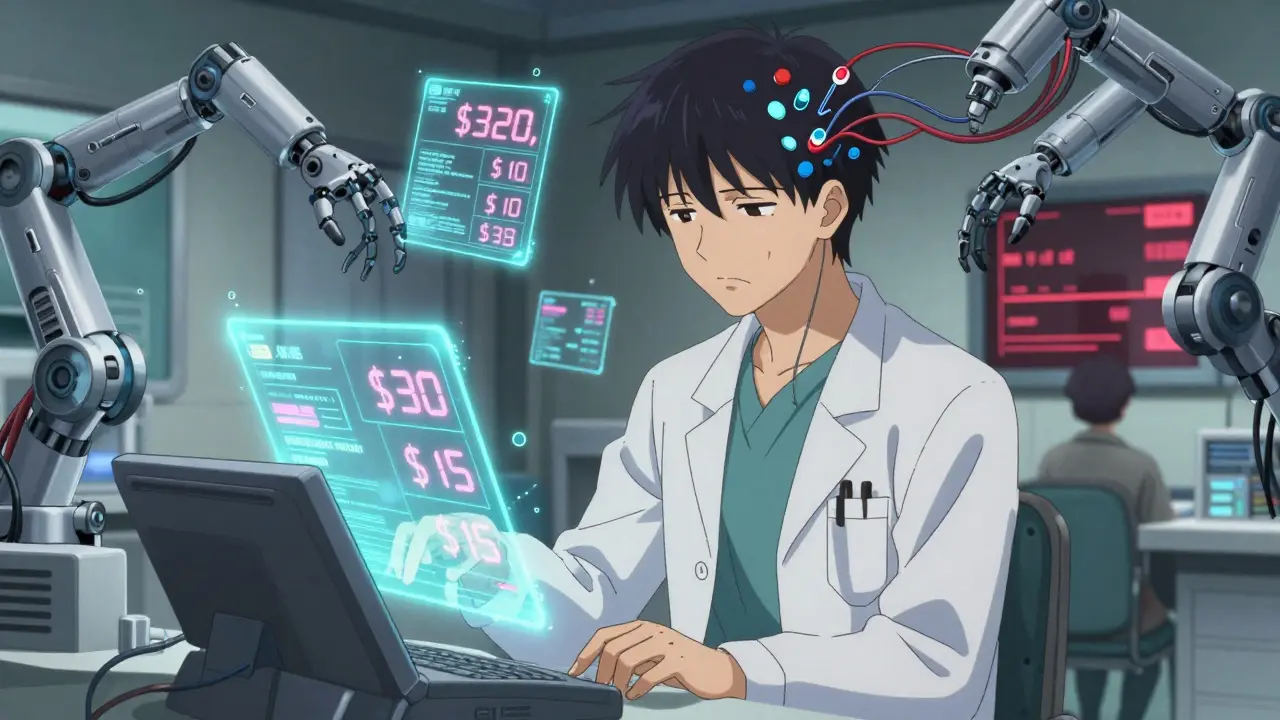
Imagine you’re a doctor. Your patient asks if there’s a cheaper option for their blood pressure medication. You reach for your phone, open a drug database, type in the name, and wait-three minutes later, you find the answer. But you’re already 15 minutes behind schedule. You prescribe the drug anyway, not because it’s the best choice, but because you don’t have time to dig deeper. This isn’t hypothetical. It’s happening in clinics across the U.S. every day.
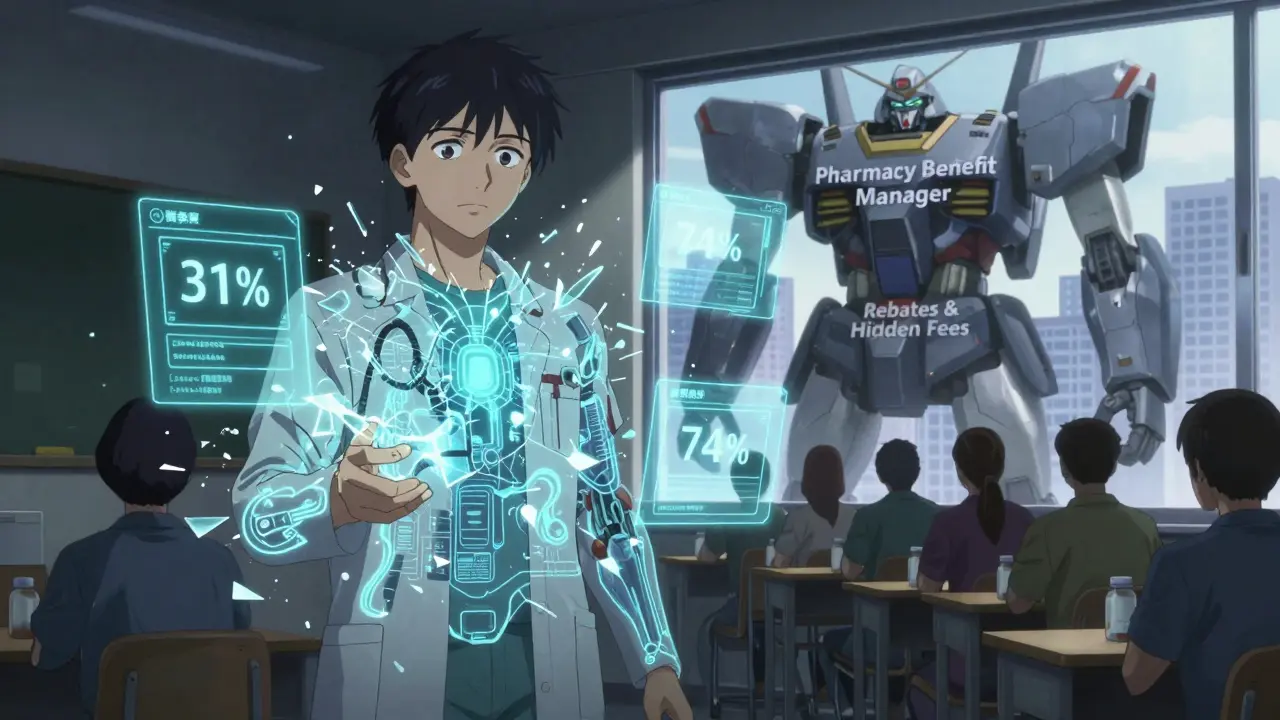
A 2007 review of 29 studies found that doctors consistently get drug prices wrong. They overestimate the cost of cheap generic pills by 31% and underestimate expensive brand-name drugs by 74%. That’s not a small mistake. It means patients are being prescribed more expensive drugs when cheaper, equally effective options exist. And the system isn’t helping.
Why does this gap exist?
Drug prices in the U.S. are a mess. The same medication can cost $15 at one pharmacy and $320 at another, depending on insurance, location, and even the time of day. There’s no single source of truth. Medicare Part D formularies change monthly. Private insurers have their own negotiated rates. Pharmacy benefit managers (PBMs) hide the real prices behind layers of rebates and discounts. Even if a doctor wanted to know the exact out-of-pocket cost for a patient, they can’t-not without spending precious minutes searching.
Medical schools barely teach this. A 2021 study found that 56% of U.S. medical schools have no formal curriculum on drug pricing. Students graduate knowing how a drug works, but not how much it costs. One survey of medical students showed only 13.7% could accurately estimate the price of a proprietary drug within 25% of its actual cost. For generics? Just 5.4% got it right.
And it’s not just students. Even experienced physicians struggle. In one study of 254 doctors and trainees, only 30% correctly estimated the dispensing cost of a medication. Eighty-four percent of doctors could name at least one source for drug pricing info-but most said they couldn’t access it quickly enough during a patient visit.
What happens when doctors don’t know the cost?
Patients skip doses. They stop filling prescriptions. They choose between food and medicine.
In 2023, the Kaiser Family Foundation found that 28% of adults in the U.S. didn’t take their medication as prescribed because of cost. That’s one in four. For chronic conditions like diabetes or hypertension, that’s not just inconvenient-it’s dangerous. High blood pressure doesn’t care if a patient can’t afford the pill. It just keeps rising.
Doctors aren’t ignoring cost-they’re blind to it. A 2021 JAMA Network Open study showed that when EHR systems added real-time cost alerts, doctors changed prescriptions in 12.5% of cases. That number jumped to 16.7% when the potential savings were over $20 per month. That’s not a small impact. That’s thousands of patients getting affordable care because a simple pop-up changed a doctor’s decision.
Technology is helping-but slowly
Some hospitals are fixing this. UCHealth, a major health system in Colorado, spent 18 months and $2.3 million building a tool that shows patients’ actual out-of-pocket costs right in the EHR. When doctors saw the real price, they changed prescriptions 12.5% of the time. In safety-net clinics serving low-income patients, that number rose to 22%. That’s not just better prescribing-it’s equity.
But most clinics don’t have that tool. As of Q3 2024, only 37% of U.S. hospitals had implemented real-time benefit tools (RTBTs). Many of the ones that do still get it wrong. Residents on Reddit complained that the alerts show insurer prices, not patient copays. One resident wrote: “It says the drug costs $10, but my patient’s copay is $85 because of their deductible. The system doesn’t even know.”
And even when the tech works, adoption is uneven. Doctors under 40 are 50% more likely to use cost alerts than those over 55. Why? Because younger clinicians grew up with digital tools. They expect information to be fast, accurate, and right in front of them. Older doctors, trained in a time when drug prices were stable and predictable, often don’t trust the numbers-or don’t have the time to learn the system.
Cost isn’t just about price-it’s about value
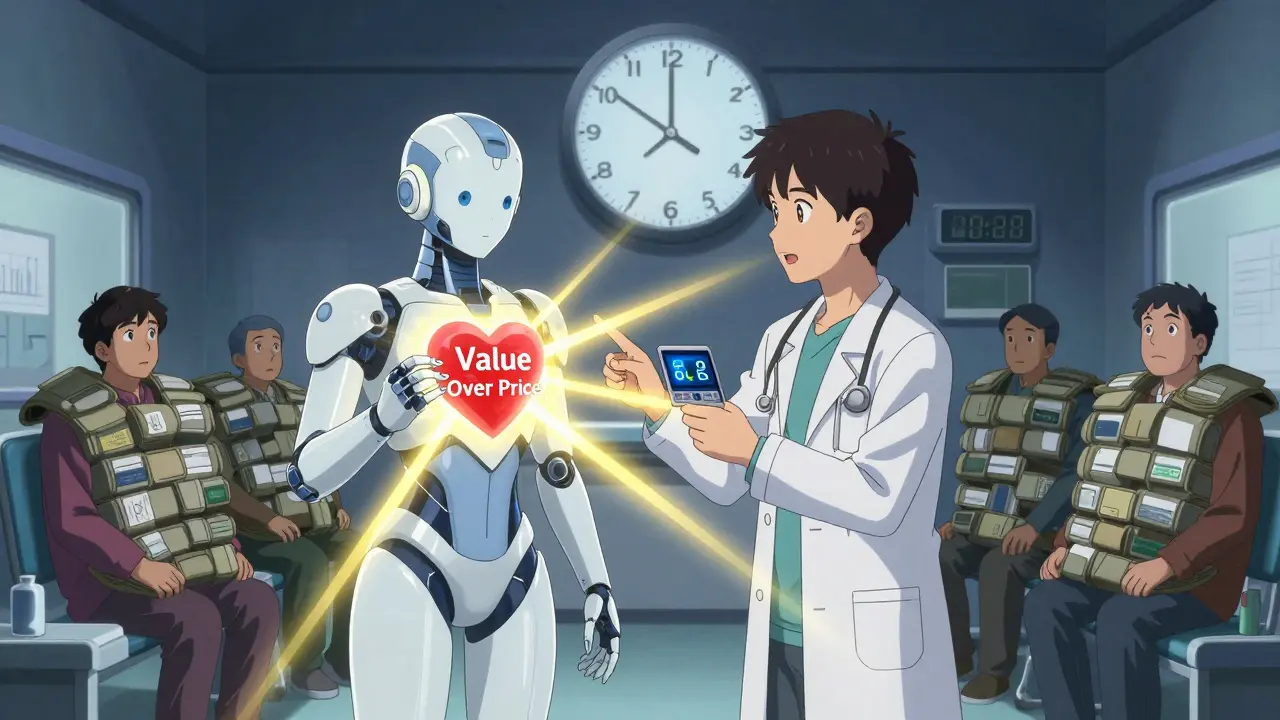
Some economists argue that doctors shouldn’t focus on price at all. They say clinicians should only care about clinical outcomes. But that ignores reality. A drug that works perfectly but costs $1,200 a month isn’t a win if the patient can’t take it. Value isn’t just efficacy-it’s accessibility.
The 2022 Inflation Reduction Act changed the game. For the first time, Medicare can negotiate prices for certain high-cost drugs. Drugs like Humira saw price hikes of 4.7% in 2023 with no new clinical benefit. That’s not innovation-it’s exploitation. And patients are paying the price.
Now, doctors are being asked to do more than prescribe. They’re being asked to judge value. Is this drug truly better than a $10 generic? Is the extra cost justified? Without reliable data, they can’t answer. And that’s the problem.
What’s being done to fix it?
Change is happening-but it’s slow. The American Medical Association and the American College of Physicians have both made cost-conscious prescribing a professional priority since 2015. The Mayo Clinic publishes a quarterly Drug Cost Resource Guide that’s rated 4.7 out of 5 by its users. Harvard and UCHealth are studying whether cost alerts reduce racial disparities in medication access. Early results show safety-net clinics benefit more.
But education still lags. Only 20% of medical schools require a course on drug pricing. Residents learn it on the job-through trial and error. One internal medicine resident told me: “I didn’t know insulin cost $250 until my patient cried in the exam room because she was choosing between insulin and rent.”
Tools are improving. The Centers for Medicare & Medicaid Services now require drugmakers to report out-of-pocket costs. EHR vendors like Epic and Cerner are building better integration. But until every clinic has real-time, patient-specific pricing at their fingertips, doctors will keep guessing.
What patients can do
You don’t have to wait for the system to fix itself. If you’re on a prescription, ask your doctor: “Is there a cheaper alternative?” or “Can we check what my copay will be?” Bring up cost early. Don’t wait until you get the bill.
Use tools like GoodRx or SingleCare. They’re not perfect, but they’re better than nothing. And if your pharmacy says a drug costs $300, ask if there’s a different location nearby that charges less. Prices vary wildly-even within the same city.
Doctors want to help. But they’re drowning in data, time, and complexity. When you speak up, you’re not being difficult-you’re making their job easier.
The path forward
Cost awareness isn’t optional anymore. With $621 billion spent on prescription drugs in 2022-and 82% of adults saying prices are unreasonable-it’s a moral and clinical imperative.
The solution isn’t just better tech. It’s better training. It’s real-time data. It’s accountability. And it’s asking the right question at the right time: “Is this the best option for my patient-financially and medically?”
The tools exist. The data is there. The will is growing. What’s missing is the urgency. And that’s something every clinician, every patient, and every policymaker can change-starting today.

Sarah Triphahn
January 15, 2026 AT 00:24Doctors are just as clueless as patients about prices. I get it, they’re busy. But if you’re prescribing a $300 pill and there’s a $5 generic that does the same thing, you’re not helping-you’re profiting off ignorance. This isn’t medicine, it’s casino economics.
Allison Deming
January 15, 2026 AT 07:45The systemic failure to integrate cost transparency into clinical practice reflects a profound moral lapse in medical education. We train physicians to diagnose, to treat, to cure-yet we deliberately omit the most fundamental determinant of therapeutic success: affordability. When a patient must choose between insulin and rent, the clinical decision tree collapses. This is not a logistical gap; it is an ethical catastrophe.
Susie Deer
January 16, 2026 AT 16:32America is broken. We pay more for drugs than any country on earth and get worse outcomes. Doctors don’t know prices because the system is designed to hide them. Pharma and PBMs are laughing all the way to the bank while people die because they can’t afford their meds. Fix the system not the doctors
Alvin Bregman
January 18, 2026 AT 16:15i mean yeah doctors are overwhelmed but also like… why dont we just make a simple app that shows real copays? its not that hard. i used goodrx last week and saved 70 bucks on my antihypertensive. why cant the ehr just do that? the tech exists its just not being used
Gregory Parschauer
January 19, 2026 AT 17:23This is what happens when you commodify healthcare. The entire model is predicated on extraction. Doctors are not villains-they’re cogs in a machine that incentivizes overprescribing and obscures cost. The real problem isn’t ignorance-it’s capitalism. Until we dismantle the PBM-pharma-industrial complex, no EHR alert will save a single life. This isn’t a policy failure. It’s a moral bankruptcy.
Henry Sy
January 20, 2026 AT 09:28my cousin’s a resident and she told me last week she prescribed a $200 med because she thought it was $15. turns out the patient’s copay was $180. the system told her the wholesale price. the patient cried. the resident cried. nobody got fired. that’s the american dream right there
Anna Hunger
January 20, 2026 AT 14:52The integration of real-time cost data into electronic health records is not merely a technological enhancement-it is a clinical imperative. Without this data, clinicians are practicing medicine in the dark, potentially causing iatrogenic harm through financial toxicity. Institutions that have implemented such tools report statistically significant improvements in medication adherence and patient satisfaction. The evidence is unequivocal. Delay is indefensible.
Jason Yan
January 22, 2026 AT 02:21I think we’re missing the bigger picture. It’s not just about prices-it’s about trust. Patients don’t trust that their doctor is choosing the best option. Doctors don’t trust that the system is giving them the right numbers. And the system? It doesn’t trust either of them to make the right call without a nudge. We need to rebuild that trust, one transparent interaction at a time. A simple pop-up doesn’t fix everything, but it says: I see you. I’m trying.
shiv singh
January 23, 2026 AT 20:43you think this is bad? wait till you see what happens in india. doctors here dont even have access to generic names. they prescribe by brand because the reps give them free samples and kickbacks. at least in the us you can use goodrx. here you just pay or die. this whole conversation is so privileged
Robert Way
January 25, 2026 AT 16:06i think the real issue is that doctors arent trained to care about money like patients do. i mean they went to school for 10 years and now theyre supposed to be financial advisors too? its unfair. also i think ehrs are trash anyway. my doc used to just ask me if i could afford it and i told him and we figured it out. why do we need tech for that?