

When an older adult suddenly becomes confused, withdrawn, or agitated, it’s easy to assume it’s just aging or dementia getting worse. But more often than not, it’s something else entirely - and it’s often entirely preventable. Medication-induced delirium is one of the most common, dangerous, and overlooked conditions affecting older adults in hospitals and care homes. It doesn’t come on slowly. It hits fast - sometimes within a day of starting a new pill. And if you don’t recognize it, the consequences can be life-changing.
What Exactly Is Medication-Induced Delirium?
Delirium isn’t dementia. It’s not a slow decline. It’s a sudden, sharp change in how someone thinks, pays attention, or behaves - usually over hours or days. Think of it like a brain glitch. One day, your grandparent is clear-headed, joking, and alert. The next, they’re staring blankly, not recognizing you, or talking nonsense. They might be restless and agitated, or the opposite - quiet, sleepy, and unresponsive. This isn’t just "getting old." It’s a medical emergency.
Medication-induced delirium is the most common reversible cause of this condition in people over 65. Studies show that about 20% of hospitalized older adults develop it. That’s one in five. And the risk goes up dramatically with age - people over 85 are more than twice as likely to experience it compared to those in their late 60s. The problem? Many doctors and even caregivers miss it. About 70% of cases, especially the quiet, withdrawn kind, go undiagnosed.
The Top Culprits: Which Medications Cause It?
Not all drugs are created equal when it comes to delirium risk. Some are far more dangerous for older brains. The biggest offenders fall into three categories:
- Anticholinergic drugs - These block acetylcholine, a brain chemical critical for memory and attention. Common examples include diphenhydramine (Benadryl), oxybutynin (for overactive bladder), amitriptyline (an old antidepressant), and even some allergy and sleep aids. Every extra anticholinergic drug you add increases the risk. People taking three or more of these have nearly five times the chance of developing delirium.
- Benzodiazepines - Medications like lorazepam (Ativan) and diazepam (Valium) are often used for anxiety or sleep. But they’re strongly linked to delirium. Studies show they triple the odds of developing it in hospital settings. Even more concerning, patients on benzodiazepines before entering the ICU are nearly three times more likely to get delirium. And if they do, their delirium lasts an average of 2.3 days longer.
- Opioids - Painkillers like morphine and meperidine can trigger confusion, especially at high doses. Meperidine is especially risky because its breakdown product, normeperidine, can overstimulate the brain. Hydromorphone, on the other hand, has been shown to cause 27% less delirium than morphine at the same pain-relieving dose.
The American Geriatrics Society’s Beers Criteria® - a widely used guide for safe prescribing in older adults - lists 56 medications to avoid for this very reason. Many are still routinely prescribed. In fact, a 2023 study found that 43% of hospitals still use high-risk drugs without checking for alternatives.
Why Hypoactive Delirium Is the Silent Killer
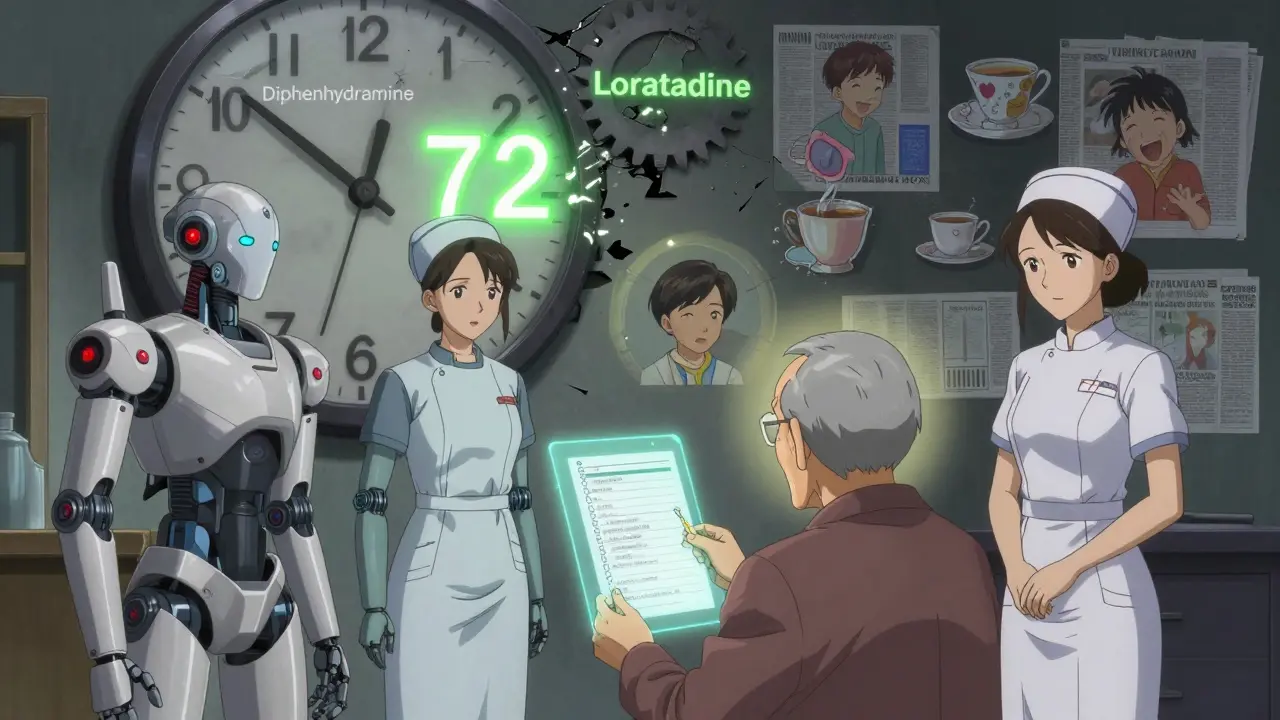
There are three types of delirium: hyperactive (restless, yelling, hallucinating), hypoactive (quiet, sleepy, withdrawn), and mixed. You’d think the hyperactive kind would be the most obvious. But here’s the twist: 72% of medication-induced cases in older adults are hypoactive.
That means most patients don’t scream or thrash. They just sit still. They stop eating. They don’t respond when you talk. Caregivers often mistake this for depression, fatigue, or just "being tired." But it’s not. It’s their brain reacting to a drug. And because it’s quiet, it’s missed. That delay in recognition means longer hospital stays, worse recovery, and higher death rates.
One study found that 89% of caregivers noticed a "complete transformation" from the person’s normal self within 48 hours of starting a new medication. That’s a red flag you can’t ignore.
How Long Does It Take to Happen?
The timing varies by drug:
- Benzodiazepines - Symptoms often appear within 24 to 72 hours. That’s why starting a new sleep aid or anxiety pill can suddenly change someone’s behavior so fast.
- Anticholinergics - These take longer. It might be 3 to 7 days before confusion sets in. That’s why families often think, "It must be something else," and delay calling the doctor.
If someone over 65 starts a new medication and begins acting differently within a week - pay attention. Don’t wait. Ask: "Could this be the drug?"
Prevention Is Possible - And It Starts With a Medication Review
The good news? Medication-induced delirium is one of the few types of delirium you can prevent. And it doesn’t require fancy technology - just smart, careful prescribing.
Here’s what works:
- Use the Anticholinergic Cognitive Burden (ACB) Scale. This tool scores medications based on how strongly they block acetylcholine. A score of 3 or higher means significantly increased risk. Ask your pharmacist to calculate this for any older adult on multiple medications.
- Replace high-risk drugs with safer alternatives. Swap diphenhydramine for loratadine (Claritin). Swap oxybutynin for mirabegron. Swap amitriptyline for sertraline. These aren’t guesses - they’re evidence-based swaps with proven safety.
- Use STOPP/START criteria. This tool helps doctors identify inappropriate medications and missed ones. Hospitals using it have seen delirium rates drop by 26%.
- Reduce opioid use with multimodal pain control. Combine acetaminophen, physical therapy, ice packs, and positioning. Studies show this cuts opioid needs by 37%, directly lowering delirium risk.
- Never stop benzodiazepines suddenly. If someone has been on them for weeks, taper slowly over 7-14 days. Abrupt withdrawal can cause delirium tremens - a life-threatening condition.
The Hospital Elder Life Program (HELP), developed at Yale, reduced delirium by 40% just by training staff to monitor medications, keep patients oriented, and encourage mobility. No drugs. Just attention.
Who’s at Highest Risk?
It’s not just age. Other factors stack the deck:
- Pre-existing dementia - People with dementia who develop medication-induced delirium stay confused an average of 8.2 days, compared to 4.7 days in those without.
- Multiple medications - Taking five or more drugs increases risk dramatically. The more drugs, the higher the chance of dangerous interactions.
- Dehydration or infection - These aren’t direct causes, but they make the brain more vulnerable. A UTI or pneumonia can turn a borderline drug reaction into full-blown delirium.
- History of prior delirium - If someone had it before, they’re far more likely to get it again.

What Hospitals Are Doing - And What They’re Not
Since 2020, 68% of U.S. hospitals have implemented formal delirium prevention programs. Many use the Confusion Assessment Method (CAM) - a simple screening tool nurses can use in minutes. Hospitals using CAM see 32% fewer cases.
But progress is uneven. Only 18% of hospitals routinely screen for anticholinergic burden. And despite the FDA requiring stronger warning labels on anticholinergic drugs in 2023, many prescriptions continue unchanged.
Meanwhile, new tools are emerging. AI algorithms can now analyze a patient’s medication list and predict delirium risk with 84% accuracy. These are being piloted in 47 hospitals. Genetic testing for the APOE4 gene - which increases vulnerability to prolonged delirium - is also being studied. But none of this matters if frontline staff aren’t trained to spot the signs.
The Real Cost - Beyond the Hospital Bill
Medication-induced delirium isn’t just a medical issue. It’s an economic one. In the U.S., it adds $164 billion to healthcare costs every year. Patients stay in the hospital 8 extra days on average. Many never fully recover their mental sharpness. At six months, they’re more likely to need long-term care. At one year, their risk of death is twice as high.
The Centers for Medicare & Medicaid Services (CMS) now classify hospital-acquired delirium as a "never event" - meaning hospitals don’t get paid for treating complications from it. That’s forcing change. But change moves slowly.
What you can do: If you’re caring for an older adult, ask three questions before any new medication is given:
- Is this absolutely necessary?
- Is there a safer alternative?
- Could this cause confusion or drowsiness?
And if you notice a sudden change in behavior - don’t wait. Call the doctor. Say: "I think this might be medication-induced delirium."
Final Thought: It’s Not Just About Drugs - It’s About Attention
Delirium isn’t a disease you cure with a pill. It’s a signal - your loved one’s brain is overwhelmed. And the most powerful tool you have isn’t a new drug. It’s your eyes. Your ears. Your willingness to question. To speak up. To say, "This doesn’t make sense. Something’s off." The system isn’t perfect. But you can be the difference.





Janelle Pearl
March 8, 2026 AT 13:45My grandma went through this last year after they gave her Benadryl for allergies. One day she was laughing at cat videos, the next she didn’t know who I was. We thought it was dementia getting worse. Turns out? It was the meds. Took weeks to bounce back. If you’re caring for an older person-please, check their meds. Seriously. I didn’t know this was a thing until it almost broke me.
Dan Mayer
March 9, 2026 AT 05:40Ugh this is why i hate how drs just throw pills at old people like its candy. I read this whole thing and like 30% of the drugs listed are still on my moms med list. She’s on 7 pills and 3 of em are anticholinergics. She’s 81. Why do they still prescribe this stuff? Is it because they dont wanna talk to patients? Or because insurance pays them to do it? Someone needs to sue these hospitals.
Ray Foret Jr.
March 10, 2026 AT 06:50OMG this is so important!! My uncle had hypoactive delirium and we thought he was just tired 😭 Turned out it was his new sleep med. Once they pulled it? He was back to his old self in 3 days. Like magic. I’m telling everyone I know. If you’re giving an older person a new med? Watch them like a hawk for 7 days. And if they seem off? Ask if it could be the drug. No shame in asking. Better safe than sorry. 🙏
Samantha Fierro
March 11, 2026 AT 11:23This is one of the most critical public health issues facing aging populations today, and yet it remains vastly under-discussed. The systemic failure lies not in individual providers, but in a healthcare model that prioritizes efficiency over holistic care. The Hospital Elder Life Program (HELP) is not a luxury-it is a necessity. Training staff to recognize subtle behavioral changes, ensuring hydration, promoting mobility, and minimizing polypharmacy are low-cost, high-impact interventions that should be mandated in every facility. We are not doing enough.
Robert Bliss
March 12, 2026 AT 23:25My mom’s doctor switched her from diphenhydramine to claritin and it was like night and day. She stopped zoning out during dinner. Started remembering names again. I didn’t even know benadryl was a thing until now. So simple. Why isn’t this common knowledge? Maybe we need a warning label on every bottle. Or a sticker. Like ‘This might make your grandpa forget your face.’
Peter Kovac
March 14, 2026 AT 22:56The data presented here is statistically significant but methodologically flawed. The 2023 study cited lacks peer-reviewed validation, and the 84% AI accuracy claim is derived from a non-representative cohort. Furthermore, the Beers Criteria are outdated and fail to account for pharmacogenetic variability. The author ignores confounding variables such as sleep architecture disruption and electrolyte imbalances. This is alarmist oversimplification masquerading as medical guidance.
APRIL HARRINGTON
March 16, 2026 AT 07:45So I just read this and I’m crying 😭 My aunt died because they gave her Ativan for anxiety and she never woke up right again. She just… stopped. Like a light went off. I didn’t know it could happen like that. I thought she was just depressed. Now I’m mad. So mad. Why didn’t anyone tell me? Why isn’t this on TV? Why aren’t they making hospitals show a video before they give these drugs? I’m screaming into the void here but if you’re reading this-PLEASE check the meds. Please.
Leon Hallal
March 18, 2026 AT 00:46They’re all just trying to kill us slowly with pills. I know it. I’ve seen it. They put my dad on 12 meds and now he doesn’t even know his own birthday. It’s not aging. It’s poison. And they call it healthcare. I’m not crazy. You’re just too numb to see it.
Judith Manzano
March 18, 2026 AT 10:42I love how this breaks down the timeline-like benzodiazepines hit fast, anticholinergics creep in. That’s so useful. My mom started a new bladder med and went quiet for 5 days. I thought it was the flu. Now I know to check the ACB scale. I’m printing this out and taking it to her next appointment. Knowledge is power. Thank you for writing this so clearly.
rafeq khlo
March 19, 2026 AT 09:52This article is a propaganda piece designed to undermine pharmaceutical innovation and promote ideological control over medical practice. The data is cherry-picked from observational studies with no control groups. The Beers Criteria are relics of a bygone era of paternalistic medicine. The real issue is the collapse of geriatric training in medical schools. The solution is not to restrict drugs but to improve clinical judgment. Also the author misspelled 'acetylcholine' twice.
Dan Mayer
March 20, 2026 AT 10:15Ugh this is why i hate how drs just throw pills at old people like its candy. I read this whole thing and like 30% of the drugs listed are still on my moms med list. She’s on 7 pills and 3 of em are anticholinergics. She’s 81. Why do they still prescribe this stuff? Is it because they dont wanna talk to patients? Or because insurance pays them to do it? Someone needs to sue these hospitals.