
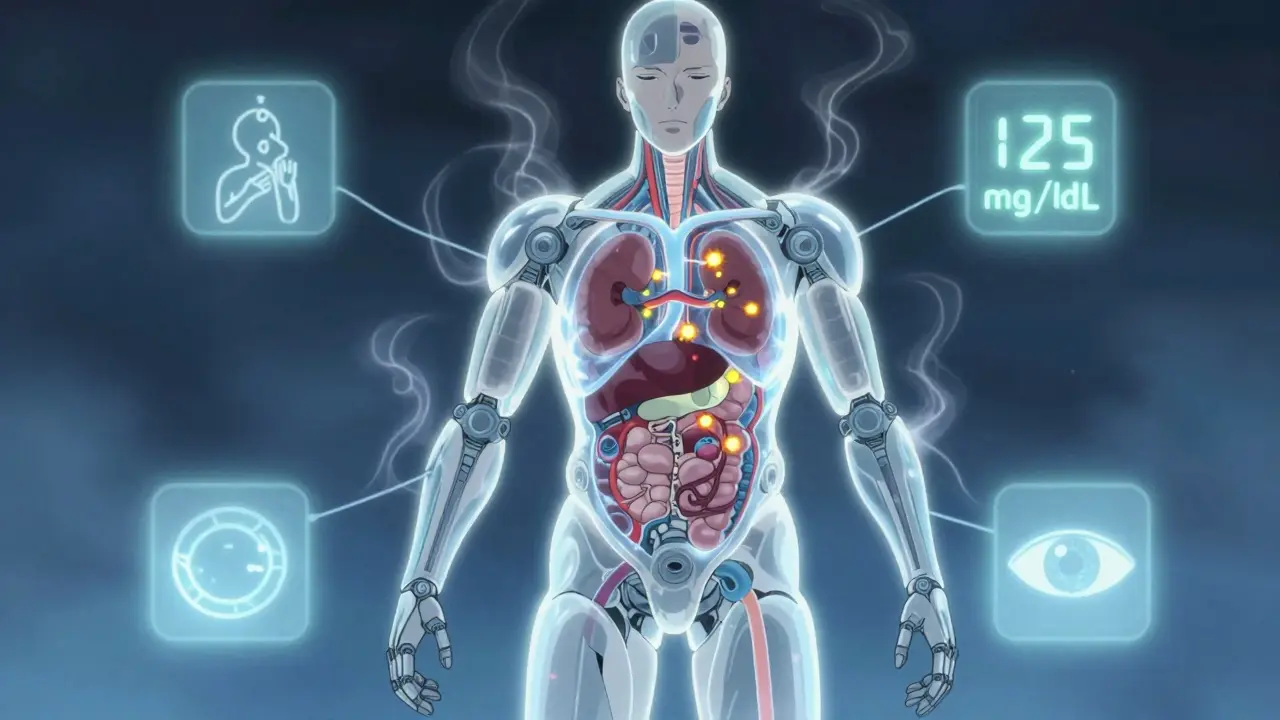
Most people with prediabetes don’t know they have it. That’s not because they’re ignoring their health - it’s because prediabetes rarely shows clear symptoms. But that doesn’t mean nothing’s happening. Your body is sending quiet signals, and if you catch them early, you can stop type 2 diabetes before it starts. This isn’t speculation. It’s science. And the good news? You don’t need medication to turn it around.
What Prediabetes Actually Means
Prediabetes means your blood sugar is higher than it should be, but not high enough to be called type 2 diabetes. Think of it like a warning light on your car’s dashboard - it’s not broken yet, but something’s off. The American Diabetes Association sets clear thresholds: a fasting blood sugar between 100 and 125 mg/dL, an A1C level between 5.7% and 6.3%, or a 2-hour glucose test result between 140 and 199 mg/dL. These aren’t random numbers. They’re based on decades of research showing exactly where risk begins.
More than 96 million adults in the U.S. have prediabetes. That’s nearly 1 in 3 people. And here’s the kicker: over 80% of them have no idea. Why? Because the body doesn’t scream. It whispers. And most people don’t know what to listen for.
The Quiet Signs You Can’t Ignore
Yes, prediabetes often has no symptoms. But when signs do appear, they’re not vague. They’re specific, measurable, and linked directly to how your body handles sugar.
- Constant thirst - drinking more than 3 liters of water a day without exercise? That’s your kidneys trying to flush out excess glucose. When blood sugar climbs above 180 mg/dL, your kidneys can’t reabsorb it all. So they pull water from your tissues, leaving you dehydrated and constantly reaching for the bottle.
- Frequent urination - going more than 8 times a day? It’s not just coffee. Your body is dumping sugar through urine, dragging water with it. This isn’t normal aging. It’s a metabolic red flag.
- Blurred vision - glasses that suddenly don’t work right? High blood sugar causes fluid to swell the lenses in your eyes. That’s why your vision gets fuzzy. It’s temporary, but it’s a sign your body is struggling to regulate glucose.
- Unexplained fatigue - even after a full night’s sleep, you feel drained? Your cells aren’t getting the fuel they need. Insulin resistance means glucose stays in your bloodstream instead of entering your muscles and brain. Energy crashes aren’t just stress. They’re biology.
- Dark, velvety patches - look at your neck, underarms, or groin. If the skin looks dirty, thickened, or darker than usual, that’s acanthosis nigricans. It’s not dirt. It’s a visible sign of insulin resistance. The body releases extra insulin to compensate, and that triggers skin changes.
- Slow healing cuts - a scrape that takes more than two weeks to heal? High sugar slows circulation and weakens your immune response. Wounds don’t just take longer to close. They’re more likely to get infected.
- Tingling or numbness - pins and needles in your hands or feet? That’s early nerve damage from sustained glucose above 140 mg/dL. It’s not arthritis. It’s diabetic neuropathy, and it starts before you’re diagnosed with diabetes.
- Increased hunger - eating more but still feeling hungry? Your cells are starved for energy, even though there’s plenty of sugar in your blood. Your brain thinks you’re starving and keeps signaling for food.
- Recurrent infections - yeast infections three or more times a year? Or UTIs that keep coming back? High sugar feeds bacteria and fungi. Women with prediabetes often notice changes in vaginal health, menstrual cycles, or fertility.
- Unexplained weight loss - dropping 5% of your body weight without trying? Your body starts breaking down fat and muscle because it can’t use glucose properly. That’s not a good sign - it’s a warning.
Who Should Get Tested - And When
You don’t need to wait for symptoms. Screening is the only reliable way to catch prediabetes early.
The U.S. Preventive Services Task Force recommends testing every three years for adults with a BMI of 25 or higher (or 23 or higher for Asian Americans) and at least one other risk factor. Those risk factors include:
- Family history of type 2 diabetes
- Physical inactivity
- High blood pressure
- History of gestational diabetes
- Polycystic ovary syndrome (PCOS)
- Being over age 45
If you’ve already been diagnosed with prediabetes, get tested every year. That’s not overkill - it’s essential. Blood sugar can climb fast, and tracking it gives you control.

How to Reverse It - No Pills Needed
The most powerful tool you have isn’t a drug. It’s your daily routine. The landmark Diabetes Prevention Program (DPP) study proved it: losing just 5-7% of your body weight and getting 150 minutes of moderate exercise each week cuts your risk of developing type 2 diabetes by 58%.
That’s not theoretical. It’s real. And it works better than medication. In fact, metformin - the most common diabetes drug - only reduces risk by 31%. Lifestyle changes beat pills every time.
Here’s what actually works:
- Move more - 150 minutes a week means 30 minutes, five days a week. Walk. Swim. Dance. Ride a bike. It doesn’t have to be intense. Just consistent. Studies show even short bursts of activity - like 10-minute walks after meals - help lower post-meal blood sugar spikes.
- Eat smarter - focus on whole foods: vegetables, beans, lean proteins, nuts, and whole grains. Cut out sugary drinks, refined carbs (white bread, pastries, chips), and processed snacks. You don’t need to count calories perfectly. Just reduce portion sizes. A 2023 study in Diabetes Care found that people who followed a Mediterranean-style diet (lots of olive oil, fish, veggies) and cut calories by 500 per day reversed prediabetes in nearly 28% of cases within a year.
- Sleep well - poor sleep increases insulin resistance. Aim for 7-8 hours. If you snore or wake up tired, get checked for sleep apnea. It’s common in people with prediabetes and makes blood sugar harder to control.
- Manage stress - chronic stress raises cortisol, which raises blood sugar. Try 10 minutes of deep breathing, walking in nature, or journaling. It’s not fluff. It’s physiology.
- Track your progress - weigh yourself weekly. Measure your waist. Note how you feel. Apps like the CDC’s National Diabetes Prevention Program or digital tools like Omada Health help people stick with it. People who use digital coaching have an 85% completion rate - far higher than in-person programs.
What Doesn’t Work
There’s a lot of noise out there. Fad diets. Juice cleanses. Detox teas. None of them work for prediabetes.
Extreme low-carb diets? They can help short-term, but most people can’t keep them up. And if you cut out all carbs, you miss out on fiber-rich foods that actually improve insulin sensitivity.
Supplements like cinnamon, berberine, or chromium? Some studies show minor effects, but nothing compares to real food and movement. Don’t waste money. Focus on what’s proven.
And please - don’t wait for a diagnosis. If you’re overweight, sedentary, or have a family history, start making changes now. You don’t need to be told you’re prediabetic to act.

The Bigger Picture
Prediabetes isn’t just about your health. It’s about your future. Without intervention, 15-30% of people with prediabetes develop type 2 diabetes within five years. That means more doctor visits, more meds, more risk of heart disease, kidney failure, and vision loss.
But here’s the flip side: if you act early, you can reverse it. The same DPP study showed that after 15 years, people who made lifestyle changes still had a 27% lower risk of diabetes than those who didn’t. That’s not a small win. That’s life-changing.
And it’s not just you. Your family, your community, your healthcare system - everyone benefits. The CDC estimates prediabetes costs the U.S. over $44 billion a year in medical bills and lost productivity. Every person who reverses it saves money and reduces strain on the system.
Start Today - Not Tomorrow
You don’t need to overhaul your life overnight. Start with one thing:
- Swap soda for water today.
- Take a 15-minute walk after dinner.
- Swap white rice for brown or quinoa at your next meal.
Small changes add up. And they’re more sustainable than drastic ones. You’re not trying to become perfect. You’re trying to become healthier - and you have more control than you think.
Prediabetes is a wake-up call. Not a life sentence. And you’re not alone. Millions are in the same spot. The difference between those who reverse it and those who don’t? Action. Not luck. Not genetics. Just daily choices.
Can prediabetes be reversed completely?
Yes, in many cases. Studies show that with consistent lifestyle changes - losing 5-7% of body weight and getting 150 minutes of exercise per week - up to 60% of people can return their blood sugar to normal levels. Some people even see their A1C drop below 5.7%, which means they’re no longer classified as prediabetic. It’s not permanent unless you maintain the habits.
Do I need medication if I have prediabetes?
Not usually. Lifestyle changes are more effective than medication for preventing type 2 diabetes. Metformin is sometimes prescribed for high-risk individuals, especially those with obesity or a history of gestational diabetes, but it’s not the first line of defense. Most doctors recommend trying diet, movement, and weight loss first. If those don’t work after 6-12 months, then medication may be considered.
How often should I get my blood sugar checked?
If you’re at risk (overweight, over 45, family history), get tested every three years. If you’ve already been diagnosed with prediabetes, get tested every year. Some doctors recommend an A1C test every six months for those actively working to reverse it. Don’t wait until you feel symptoms - by then, it may be too late.
Can I reverse prediabetes without losing weight?
It’s harder, but still possible. Exercise alone improves insulin sensitivity, even without weight loss. One study showed that people who started walking 30 minutes a day improved their blood sugar control within 8 weeks, even if their weight stayed the same. But combining movement with even modest weight loss (5-7%) gives the best results. If you can’t lose weight, focus on improving your diet quality and activity level - both matter.
Is prediabetes the same as insulin resistance?
Prediabetes is often caused by insulin resistance, but they’re not the same thing. Insulin resistance is when your body’s cells don’t respond well to insulin, so glucose builds up in the blood. Prediabetes is the diagnosis you get when blood tests show your glucose levels are too high. You can have insulin resistance without prediabetes (if your glucose is still normal), and in rare cases, prediabetes can be caused by reduced insulin production instead. But for most people, the two go hand in hand.
If you’ve read this far, you’re already ahead of most people. You’re not ignoring the signs. You’re looking for answers. That’s the first step. Now take the next one - today.


Sumit Mohan Saxena
February 28, 2026 AT 15:22Prediabetes is a metabolic condition that demands clinical vigilance. The physiological markers you've outlined are well-documented in peer-reviewed literature, particularly in the context of insulin signaling dysregulation. The ADA thresholds are not arbitrary; they reflect longitudinal data from the Framingham cohort and the UKPDS study. The key intervention remains lifestyle modification, as evidenced by the DPP trial's 58% risk reduction. I would emphasize that HbA1c monitoring should be quarterly in high-risk individuals, not annually. Additionally, waist-to-hip ratio is a more sensitive predictor than BMI alone, especially in South Asian populations where visceral adiposity manifests at lower BMIs.
Katherine Farmer
March 1, 2026 AT 00:53Oh please. Another feel-good wellness article masquerading as medical advice. Let’s be real - the ‘lifestyle changes’ narrative is a convenient distraction from the pharmaceutical-industrial complex’s real profit engine: lifelong metformin prescriptions and GLP-1 agonists. You’re telling people to ‘walk more’ while insulin costs $300 a vial? That’s not prevention - that’s exploitation. And don’t get me started on the ‘Mediterranean diet’ hype. Olive oil doesn’t reverse insulin resistance - it just makes your salad taste better while your pancreas slowly dies.
Angel Wolfe
March 2, 2026 AT 05:49THIS IS A GOVERNMENT TRAP. They want you to think it's about diet and exercise but it's really about control. They're slowly poisoning us with high fructose corn syrup in EVERYTHING and then they make you feel guilty for eating it. They don't want you to know that glyphosate in your bread is what's wrecking your mitochondria. And the CDC? They're just fronting for Big Pharma. I've been testing my blood sugar since 2020 and it's been fine - I don't need their 'advice'. They're just trying to get you to buy their apps and wearables so they can track your every move. Wake up people. This isn't science - it's surveillance disguised as health.
Sophia Rafiq
March 3, 2026 AT 12:38Love this breakdown. Honestly the most useful part for me was the part about blurred vision - I thought I just needed new glasses but turns out my fasting glucose was 118. Started walking after dinner and swapped white rice for cauliflower rice. Didn’t even lose weight but my A1C dropped from 6.1 to 5.5 in 4 months. Also the sleep thing is real - stopped scrolling at 11 and started using blue light blockers. Energy levels are wild. No magic, just consistency. Also the 10-min walk after meals? Game changer. Just do it. No need to overthink.
Martin Halpin
March 4, 2026 AT 12:12Let me tell you something that nobody else will admit - prediabetes isn’t even the real issue. The real issue is the systemic collapse of our food infrastructure. We’ve been fed processed crap for decades, subsidized by agribusiness, and now we’re being told to just ‘eat better’? That’s like telling someone drowning to swim better. And who decides what ‘moderate exercise’ is? A bureaucrat in D.C. who’s never held a 40-hour workweek? My cousin in Dublin works two jobs and sleeps four hours. He walks 10 minutes to the bus stop. That’s not ‘inactivity’ - that’s survival. And yet they want him to ‘lose 7% body weight’? That’s not prevention - it’s punishment. The system is rigged. The data is skewed. The solutions are designed to fail. We’re being gaslit by wellness influencers and CDC pamphlets. I’m not saying don’t walk. I’m saying don’t believe the narrative. The real cure is revolution - not kale.
Charity Hanson
March 5, 2026 AT 18:18Yessss this is exactly what I needed to hear! I was diagnosed last year and I was ready to give up - felt like my body was betraying me. But then I started doing 15-minute dance breaks while cooking dinner. Just put on music and move. No gym. No tracking. Just joy. And guess what? My energy is up, my cravings are down, and I actually sleep better. It’s not about perfection - it’s about showing up for yourself. You don’t have to be a saint. Just be consistent. And if you slip? No guilt. Just try again tomorrow. You got this. I’m cheering for you. 💪❤️
Justin Ransburg
March 7, 2026 AT 17:31This is an exceptionally well-researched and balanced overview. The emphasis on evidence-based outcomes rather than anecdotal trends is commendable. The Diabetes Prevention Program data remains the gold standard, and the fact that lifestyle intervention outperforms pharmacological approaches by nearly double is a powerful testament to human agency. I would only add that psychological resilience - the ability to sustain behavioral change over time - is often the most underappreciated variable. Support systems, whether through digital platforms or community groups, are not optional accessories - they are critical components of long-term success. Thank you for providing clarity where confusion is rampant.
Brandon Vasquez
March 9, 2026 AT 06:26I’ve been working with prediabetic patients for over a decade. The most successful ones weren’t the ones who lost the most weight. They were the ones who stopped obsessing over the scale and started paying attention to how they felt. More energy. Clearer thinking. Fewer afternoon crashes. That’s the real metric. I tell them: don’t fix your numbers. Fix your rhythm. Eat when you’re hungry. Move when you’re stiff. Sleep when you’re tired. The body knows what to do. We just have to stop getting in its way. Small steps. Daily. That’s the whole game.
Vikas Meshram
March 10, 2026 AT 06:39Incorrect. The American Diabetes Association thresholds are outdated. The 2022 WHO guidelines now define prediabetes as fasting glucose above 99 mg/dL, not 100. Also, A1C 5.7% is not diagnostic - it’s borderline. You need two separate confirmatory tests. And you completely omitted the role of gut microbiota dysbiosis. Studies from the University of California show that Firmicutes/Bacteroidetes ratio is a stronger predictor than BMI. Also, your Mediterranean diet claim is misleading - olive oil is monounsaturated fat, which does not improve insulin sensitivity as much as polyunsaturated fats from flaxseed or walnuts. And you forgot to mention that intermittent fasting has been shown to reduce HOMA-IR by 32% in RCTs. This article is riddled with oversimplifications. You need to update your references.
Ben Estella
March 10, 2026 AT 17:52Let me tell you something - this country is getting soft. People think they can just walk around and eat salad and fix their blood sugar? Nah. You need discipline. Real discipline. No excuses. I work 60 hours a week, I don’t have time for your ‘15-minute walks’. I do 45 minutes of HIIT three times a week and I eat clean. No sugar. No bread. No excuses. That’s how you beat this. You want to reverse prediabetes? You gotta fight. You gotta grind. You gotta be hard on yourself. If you’re not willing to suffer for it, then you don’t deserve to be healthy. That’s America. That’s how we win.
Jimmy Quilty
March 10, 2026 AT 19:45Did you know the CDC gets funding from pharmaceutical companies? They’re the ones pushing this whole prediabetes narrative so we’ll buy more drugs later. And what’s with all these apps? Omada Health? They’re owned by a private equity firm that also owns a insulin manufacturer. This is all a setup. They want you dependent. They want you tracking. They want you scared. Meanwhile, real solutions like berberine and berberine + magnesium are being suppressed because they’re cheap and natural. I reversed mine with 500mg berberine twice a day and 20 minutes of sun exposure. No walking. No diet changes. Just biology. The system doesn’t want you to know this.
Miranda Anderson
March 11, 2026 AT 10:01I read this whole thing while sitting on my porch with a cup of tea. It made me pause. I’ve been ignoring my fatigue for years - thought it was just stress. But now I’m looking at my skin and noticing those dark patches on my neck. I didn’t realize they meant anything. I used to think it was just dirt from not washing enough. I’m going to call my doctor tomorrow. I don’t want to wait. I don’t want to be one of those 80%. I think maybe I’ve been ignoring the whispers for too long. Thank you for saying it plainly. Not everyone gets to hear this gently. I’m grateful.
Gigi Valdez
March 12, 2026 AT 19:22Thank you for writing this with such clarity and restraint. The most powerful part for me was the distinction between prediabetes and insulin resistance - it’s a nuanced but critical difference. Too often, people conflate the two and end up feeling personally blamed. This piece avoids moralizing. It simply presents biology, evidence, and agency. That’s rare. I’ve shared it with my elderly father, who has a family history of diabetes. He’s been resistant to ‘health advice’ for years. But he read it. And he said, ‘I think I’ll try the walking after dinner.’ That’s progress. Not perfection. Just progress. That’s all we need.
bill cook
March 13, 2026 AT 10:37I’ve been prediabetic for 7 years. I’ve tried everything. Keto. Intermittent fasting. Weight Watchers. Even that expensive digital coaching program. I lost 30 pounds. Then gained it back. Then I got depression. Then I got a divorce. Now I’m on meds. I don’t know if I’m angry at myself or the system. But I know this - no one told me how lonely this feels. No one said it’s okay to fail. No one said your body might not respond no matter how hard you try. I’m not a failure. But I don’t feel like I’m winning either. I just want someone to say it’s okay to be tired. And that I’m still worthy. Even if I’m still prediabetic.