

When the FDA issues a safety alert about a medication, it can feel like a red flag - especially if you’re the one taking it. But not every alert means you should stop the drug. Understanding the difference between a risk and a benefit in these announcements is critical to making smart, informed decisions. The FDA doesn’t issue these warnings lightly, but they’re not final verdicts either. They’re signals - pieces of a larger puzzle that need context to make sense.
What the FDA Actually Means by "Potential Signal"
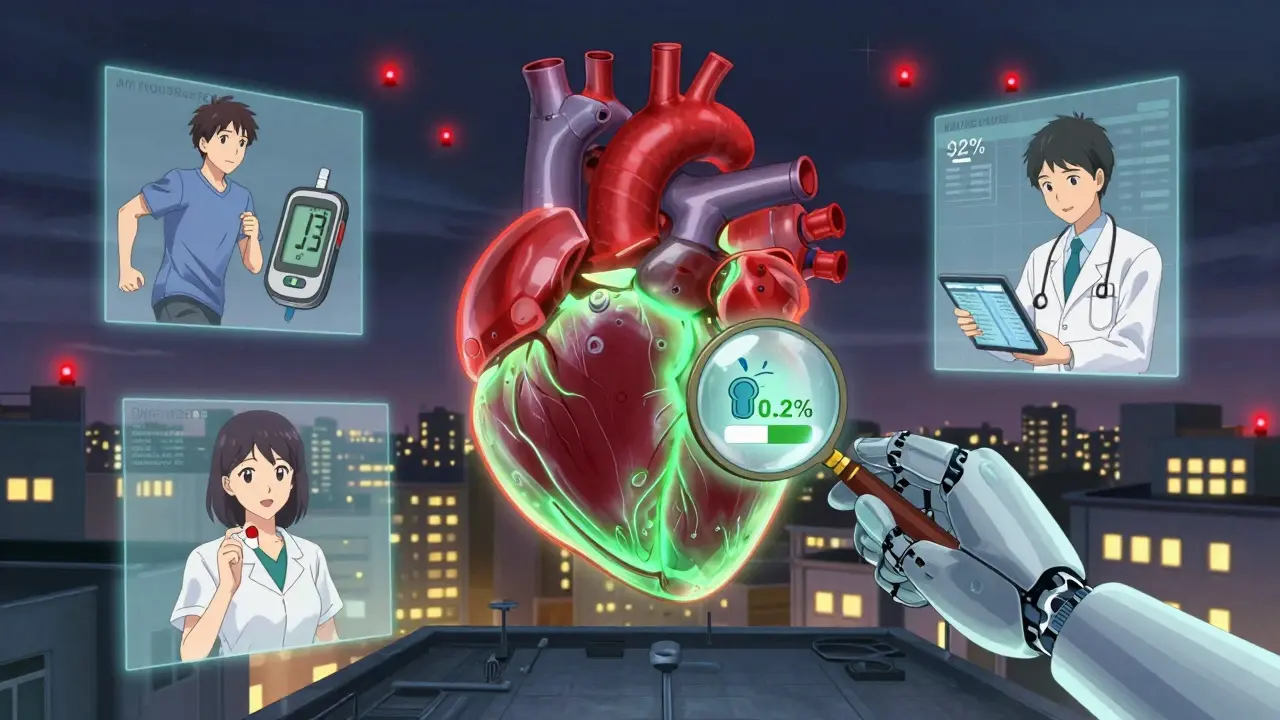
If you’ve read an FDA Drug Safety Communication, you’ve probably seen the phrase "potential signal." This isn’t a warning that the drug is dangerous. It’s a notice that something unusual showed up in the data - maybe more reports of a rare side effect than expected. The FDA doesn’t say "this drug causes X." They say, "we’re seeing more reports of X, and we’re looking into it." For example, in Q3 2023, the FDA flagged a potential signal linking a common diabetes drug to a rare genital infection called Fournier’s gangrene. The report didn’t say the drug causes it. It said: "We observed 12 cases in the past year among users of this drug class. In the general population, this condition occurs in about 0.06 cases per 1,000 patient-years. In users of this drug, it was 0.2 cases per 1,000 patient-years." That’s a threefold increase - but still extremely rare. The benefit? This drug lowers blood sugar, reduces heart failure risk, and helps with weight loss. For many people with type 2 diabetes, the benefit far outweighs the tiny risk. The FDA didn’t pull the drug. They updated the label to include the risk - and advised doctors to be aware.How the FDA Decides What’s a Real Risk
The FDA doesn’t rely on patient stories alone. They use a massive database called FAERS - the FDA Adverse Event Reporting System. As of late 2023, it contained over 25 million reports. But here’s the catch: most of those reports are incomplete. A patient might say, "I took drug X and got a headache." That’s not proof the drug caused it. Maybe they were stressed, or slept poorly, or had a virus. The FDA uses statistical tools to spot patterns. If 100,000 people take a drug and 10 of them develop a rare liver injury, but only 2 cases show up in 1 million people not taking the drug, that’s a signal. But even then, they don’t jump to conclusions. They check:- Is the event serious? (Life-threatening, hospitalization, permanent disability)
- Is it new? (Not known from clinical trials)
- Is there a plausible biological link?
- Are there other reports from different countries or studies?
Dr. Robert Temple, former top scientist at the FDA, put it simply: "The absence of evidence is not evidence of absence." Just because a side effect hasn’t been proven doesn’t mean it doesn’t exist. But the reverse is also true: a signal doesn’t equal proof.
What’s the Real Difference Between Risk and Benefit?
Risk and benefit aren’t just numbers. They’re personal. A 1 in 1,000 chance of a serious side effect means something very different if you’re treating life-threatening cancer versus mild acne. The FDA’s 2024 guidance now requires five key questions to be answered for every safety update:- How severe is the condition being treated?
- Are there other treatments available?
- How strong is the benefit?
- How often and how serious is the risk?
- Can we manage the risk? (For example, with monitoring or restricted access)
Take antidepressants like SSRIs. In 2023, the FDA issued a communication about possible menstrual changes in women taking them. The report didn’t say it was common - in fact, the risk was estimated at less than 1% of users. But the benefit? For someone with severe depression, the risk of suicide or self-harm without treatment is far higher. The FDA didn’t recommend stopping the drug. They just told doctors to ask about menstrual changes - and to weigh the trade-off.
What You Should Do When You See an FDA Alert
Don’t panic. Don’t stop your medication. Do this:- Check if it’s a "potential signal" or a "confirmed risk." Only 30% of FDA alerts are confirmed risks. The rest are under review.
- Look for numbers. If the alert says "rare" or "uncommon," ask: "How rare?" The best alerts give actual rates - like "1 in 5,000." If they don’t, it’s a red flag.
- Compare it to the baseline. What’s the natural risk for this side effect? For example, blood clots occur naturally in about 1 in 1,000 women on birth control. If a drug raises that to 2 in 1,000, that’s still very low.
- Check the label. The FDA requires drug labels to list known risks. If the new alert isn’t on the label yet, it’s still being evaluated.
- Talk to your provider. Don’t make changes alone. Bring the alert. Ask: "Does this change your recommendation for me?"
A 2022 survey of 1,200 doctors found that 42% had changed prescriptions based on an FDA alert - only to later learn the risk was negligible. That’s why context matters. A 2023 JAMA study showed that clinicians who used the FDA’s free "Drug Safety Triaging Tool" cut their interpretation time by 35% and were 50% more accurate.
Why Some Alerts Cause Unnecessary Fear
The FDA’s job is to catch risks early. But their language is cautious by design. They avoid saying "this causes" because they don’t want to scare people out of life-saving drugs. But that caution backfires. Patients hear "potential risk of X" and think, "I’m going to get X." A 2022 FDA report found that 75% of patients who read safety alerts felt confused - and 30% stopped their medication without consulting a doctor. One notorious example: in 2021, the FDA flagged menstrual delays in young women after COVID-19 vaccines. The report was clear: "No causal link was established." But headlines screamed "Vaccine causes missed periods." Thousands of women canceled their second doses. Later, data from 10 million vaccinated women showed no increase in menstrual disorders compared to unvaccinated peers. The problem? The FDA didn’t say "no risk." They said "no proven link." And the public heard "maybe."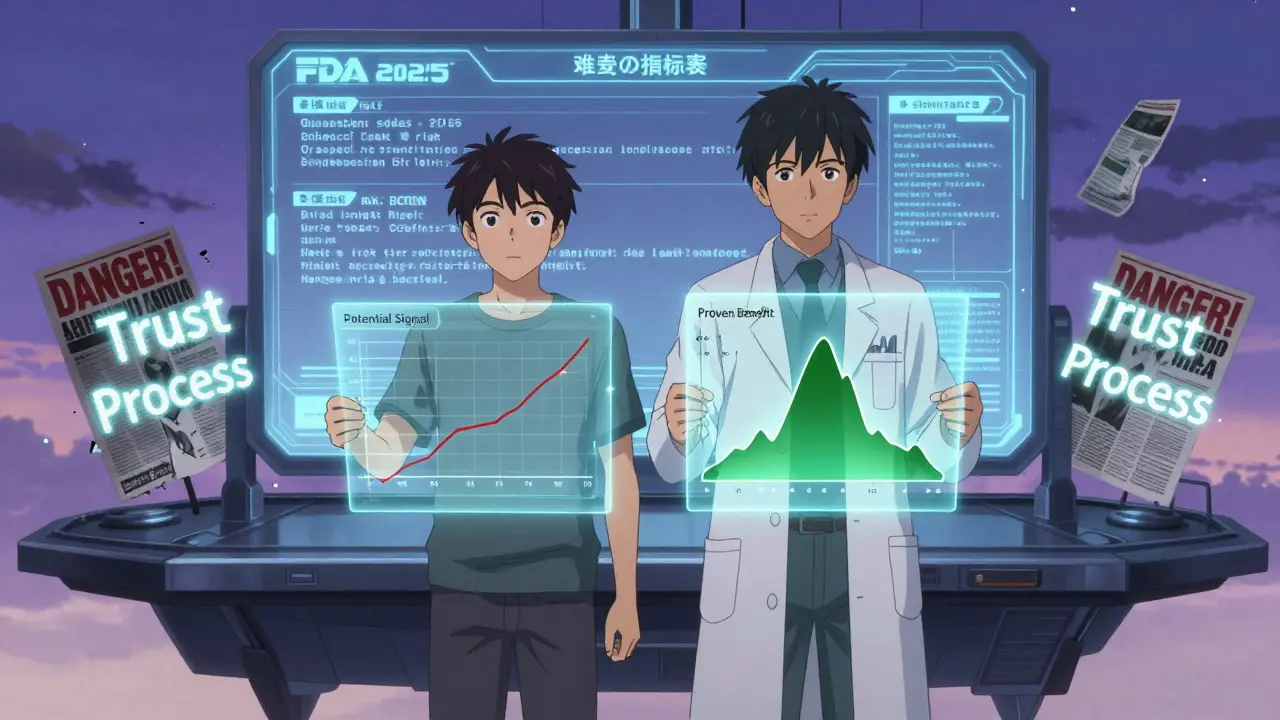
What’s Changing in 2025 and Beyond
The FDA is fixing this. By Q3 2025, all new safety alerts must include:- A clear quantitative risk estimate
- A comparison to baseline risk
- A statement on whether the benefit still outweighs the risk
- A plain-language summary for patients
They’re also launching a patient-facing tool in early 2026 that will show risk-benefit visuals - like a bar chart comparing the chance of a side effect versus the chance of avoiding a heart attack.
These changes are long overdue. The goal isn’t to scare people. It’s to empower them.
Bottom Line: Trust the Process, Not the Headline
FDA safety alerts are not verdicts. They’re checkpoints. They’re how the system learns after a drug is used by millions - not just hundreds in a trial. If you’re on a medication and see a new alert:- Don’t stop. Don’t switch. Don’t panic.
- Look for numbers. If none are given, ask for them.
- Ask your doctor: "Does this change what we’re doing?"
- Remember: most drugs have risks. But most risks are small - and often outweighed by the benefit.
The FDA’s system isn’t perfect. But it’s the best we have. And when you know how to read it, you’re not just following a warning - you’re making a smarter, safer choice.

Allison Priole
March 21, 2026 AT 19:09Okay but like… I read the FDA alert about my diabetes med and just panicked and stopped taking it for a week. My sugar went through the roof. My doctor laughed and said, 'You just became a case study.'
Turns out the risk was 0.2 per 1000. Like, you’re more likely to get struck by lightning while eating a burrito.
Stop scrolling. Talk to your doc. I’m still alive. My HbA1c is fine. 🤷♀️
Bryan Woody
March 22, 2026 AT 05:12Y’all act like the FDA is some sacred oracle when they’re basically a bunch of statisticians with too much caffeine and a fear of lawsuits.
They say 'potential signal' because if they said 'probably fine' someone would sue them when their cousin got a headache.
Meanwhile, people are dying from not taking their meds because they saw a headline that said 'drug linked to rare condition' and thought 'linked' meant 'causes'.
Get a grip. Read the actual numbers. If it’s not on the label yet, it’s not a real risk. Just a footnote waiting to happen.
Chris Dwyer
March 23, 2026 AT 18:48I love how we’ve turned medical advice into a trauma response.
You see an FDA alert and suddenly you’re in fight-or-flight mode. No chill. No nuance. Just 'I’m gonna die.'
But here’s the thing: your body’s been surviving for 30+ years without a single FDA alert. You didn’t need the government to tell you to breathe.
Take your pill. Eat your veggies. Call your doctor. Don’t let fear do the thinking for you. You got this.
Timothy Olcott
March 25, 2026 AT 06:36FAERS database? 25 million reports? LOL. That’s just people typing 'I took metformin and my dog looked at me weird' into a form.
Meanwhile Big Pharma is paying off the FDA to keep selling cancer drugs that make you cry in the shower.
They don’t want you to know the truth. They want you scared. They want you buying more pills.
Wake up. The system is rigged. 🤬
Desiree LaPointe
March 26, 2026 AT 17:38How quaint. The FDA 'updates labels' like we’re all children who can’t handle a single sentence without bullet points.
Let me guess - the next step is a 10-minute animated video with a talking pill explaining why you shouldn’t stop your antidepressant.
Meanwhile, real medicine - the kind practiced by doctors who read journals instead of press releases - has been doing risk-benefit analysis since before the FDA existed.
Maybe the problem isn’t the alert. It’s that we’ve outsourced critical thinking to bureaucrats who think 'rare' means 'imminent doom.'
Jackie Tucker
March 27, 2026 AT 03:34How dare they suggest we 'ask our doctors'? As if physicians are anything but corporate agents trained to parrot FDA script while their HMO slashes their time per patient to 7 minutes.
And yet, the real tragedy isn’t the alert - it’s that we’ve forgotten how to think for ourselves.
There’s a reason ancient physicians relied on observation, not databases.
Our ancestors didn’t need a bar chart to know when to stop bleeding.
We’ve become data zombies. And the FDA? Just the latest algorithm.
Thomas Jensen
March 29, 2026 AT 01:01Did you know the FDA banned a drug in 1998 because of 12 reports… and then it turned out 11 of those were from the same hospital?
They still don’t fix their system.
They’re scared of lawsuits so they overreact.
And now every time a woman misses a period after a vaccine, the internet explodes.
It’s not science. It’s fear porn.
And we’re all addicted.
matthew runcie
March 29, 2026 AT 13:11I’ve been on statins for 12 years. Saw the alert about muscle pain. Checked the numbers. Risk was 1 in 5000. My chance of a heart attack without it? 1 in 4.
Didn’t stop. Didn’t panic. Just asked my doctor. She said, 'Keep going.'
Simple. Real. Human.
Stop overthinking. Talk to someone who knows you.
Not the headline. Not the algorithm.
Just your doctor.
Solomon Kindie
March 30, 2026 AT 14:08The whole system is built on statistical illusions
Correlation isn't causation but they treat it like gospel
They use FAERS like its a crystal ball
Meanwhile real science takes years
And patients are left in limbo
Because bureaucracy cant handle nuance
So they overwarn
And we overreact
And nobody gets smarter
Just sadder
Natali Shevchenko
April 1, 2026 AT 06:01There’s something deeply human about how we respond to risk.
We don’t just calculate probabilities - we feel them.
That’s why a 0.2% chance of Fournier’s gangrene feels terrifying, even though it’s less likely than being crushed by a vending machine.
The FDA’s job isn’t just to report numbers - it’s to help us hold both fear and faith at once.
We need to be told: yes, this is rare.
Yes, this is real.
But no, you are not alone in this.
And yes, your life still matters more than this tiny risk.
That’s not statistics.
That’s compassion.
And we’re forgetting how to give it.
Johny Prayogi
April 1, 2026 AT 14:11Bro. I took my bipolar med. Saw the alert. Thought 'oh no.'
Called my psychiatrist. She said, 'The risk is 1 in 10,000. The benefit? You didn't try to jump off a bridge last month.'
So I kept taking it.
And I'm still here.
And I'm working.
And I'm not dead.
So stop scrolling. Talk to your provider. They're not perfect.
But they care.
And they know you.
Not the headline.
Not the fear.
You.
❤️
Nishan Basnet
April 3, 2026 AT 13:02As someone from India where access to specialists is rare and meds are often bought off the shelf, I’ve seen what happens when people panic over FDA alerts.
One patient stopped her insulin because of a 'potential signal' about kidney issues - then ended up in the ER with DKA.
The FDA doesn’t say 'stop.' They say 'be aware.'
But in places without doctors, awareness becomes fear.
We need plain-language summaries. Not just for Americans. For everyone.
Because health isn’t a privilege.
It’s a right.
And understanding risk? That’s the first step to claiming it.
Allison Priole
April 5, 2026 AT 02:31Wait I just read this comment and I’m like… yeah I did that. Stopped my med. Felt guilty. Then went back.
My doc didn’t even yell. Just said, 'Next time, text me first.'
So now I do.
Thanks for the reminder, stranger on the internet. 🤗