Most people never hear the term adrenal incidentaloma until it shows up on a scan they didn’t ask for. Maybe it was a CT for back pain, an ultrasound for abdominal discomfort, or a routine checkup imaging. Suddenly, there’s a spot on the adrenal gland - and now you’re told it needs evaluation. The good news? In about 8 out of 10 cases, it’s harmless. The bad news? You still have to go through a careful process to make sure.
What Exactly Is an Adrenal Incidentaloma?
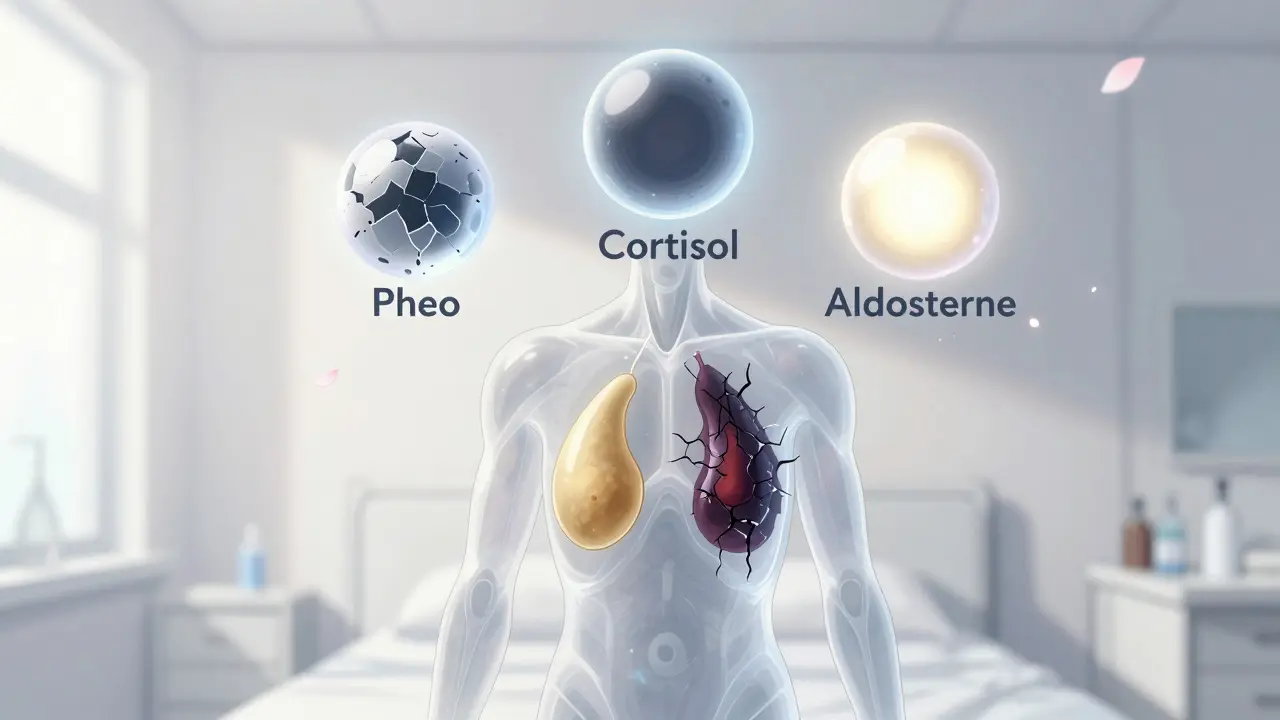
An adrenal incidentaloma is a lump on one or both adrenal glands that’s found by accident during imaging done for another reason. It’s not something you felt or symptoms led you to. The adrenal glands sit right above your kidneys and make critical hormones like cortisol, adrenaline, and aldosterone. When a mass shows up there - and it’s bigger than 1 cm - it’s classified as an incidentaloma.
These aren’t rare. Around 2% of adults have one. That number jumps to over 7% if you’re over 70. With more people getting CTs and MRIs these days, doctors are finding them more often than ever. Most are just benign, non-functioning adenomas - like little benign growths that don’t make extra hormones. But a small percentage can be dangerous.
Why Does It Matter If It’s Silent?
You might think, ‘If I don’t feel anything, why worry?’ But here’s the catch: some adrenal tumors make hormones without you knowing. That’s called autonomous secretion. A tumor could be pumping out too much cortisol, leading to weight gain, high blood pressure, or diabetes - all without classic Cushing’s symptoms. Or it could be making adrenaline, which can cause sudden spikes in blood pressure during surgery - potentially fatal if not caught beforehand.
Then there’s cancer. About 2% of incidentalomas are adrenocortical carcinomas - rare, but aggressive. Others are metastases from cancers like lung or breast. If you miss those, the consequences are serious.
The goal isn’t to remove every lump. It’s to find the ones that could kill you - and leave the harmless ones alone.
The Three Types of Adrenal Masses
Not all adrenal tumors are the same. They fall into three clear categories:
- Functioning tumors: These make hormones. That includes pheochromocytomas (adrenaline), cortisol-producing tumors, aldosterone-producing adenomas (causing high blood pressure), and rare sex-hormone tumors.
- Malignant tumors: Either primary adrenal cancer (adrenocortical carcinoma) or cancer that spread there from elsewhere.
- Benign non-functioning tumors: The majority. These include adenomas, myelolipomas (made of fat and blood cells), cysts, and hematomas. They don’t make hormones and don’t spread.
Knowing which type you have determines everything - from whether you need surgery to how often you need follow-up.
Step 1: The First Scan - CT Without Contrast
The very first test after finding an adrenal mass is usually an unenhanced CT scan. That means no dye. Why? Because the density of the tumor, measured in Hounsfield units (HU), tells you a lot.
If the mass has a density under 10 HU, there’s a 70-80% chance it’s a benign adenoma. That’s because benign adenomas are often full of fat. Malignant tumors or pheochromocytomas usually have higher density - above 10 HU - and may look irregular, have uneven edges, or show signs of bleeding.
But CT alone isn’t enough. A mass that looks benign on imaging still needs hormone testing. And a mass that looks suspicious? That’s a red flag.
Step 2: Testing for Hormones - The Critical Trio
Every single adrenal incidentaloma needs three hormone tests - no exceptions.
- Pheochromocytoma screening: This is non-negotiable. You test for metanephrines - either in a 24-hour urine sample or in plasma. If this is missed and you go into surgery, a sudden adrenaline surge can trigger a heart attack or stroke. The test is simple, but it’s often skipped in community hospitals. Only about 45% of them can run this test right away.
- Cortisol excess: The 1-mg dexamethasone suppression test is standard. You take a pill at night, then get your cortisol level checked the next morning. If it’s above 1.8 μg/dL (or 50 nmol/L), you might have subclinical Cushing’s syndrome. That’s not full-blown Cushing’s - but it still raises your risk of heart disease, diabetes, and bone loss. Around 5% of incidentalomas show this.
- Aldosterone excess: Only test for this if you have high blood pressure or low potassium. A high aldosterone-to-renin ratio suggests an aldosterone-producing adenoma. That’s treatable - and often cured with surgery.
There’s new tech on the horizon: urinary steroid metabolomics. It looks at the full pattern of steroid breakdown products in urine. Early studies show it’s 92% accurate at spotting cortisol excess - better than the dexamethasone test. It’s not everywhere yet, but it’s coming.
When Is Surgery Needed?
Not every adrenal tumor needs to come out. But here’s when it does:
- Any tumor that makes hormones: Pheochromocytoma? Surgery. Cortisol excess? Surgery. Aldosterone excess? Surgery. Even if the tumor is small, if it’s making hormones, remove it.
- Tumors larger than 4 cm: Size matters. Tumors under 4 cm have less than a 1% chance of being cancer. Once you hit 4 cm, that risk jumps. At 6 cm or more, the chance of adrenal cancer is about 25%. That’s not a gamble worth taking.
- Suspicious imaging features: Irregular shape, uneven texture, signs of invasion into nearby organs - these are red flags, even if the tumor is small.
- Rapid growth: If the tumor grows more than 1 cm per year, or doubles in volume in under a year, it’s likely malignant.
For benign, non-functioning tumors under 4 cm with normal imaging - no follow-up is needed. You’re done. No more scans. No more tests. Just live your life.
The Surgical Prep - Especially for Pheochromocytoma
If you’re having surgery, preparation is everything. For pheochromocytoma, you need alpha-blockers - like phenoxybenzamine - for at least 7 to 14 days before surgery. This stops the dangerous blood pressure spikes. Beta-blockers may come later, but only after alpha-blockade. Skipping this step is dangerous.
Most adrenal surgeries today are done laparoscopically - small cuts, fast recovery. But if the tumor is large or looks invasive, open surgery may be needed. The key is doing it at a center that does this often. Patients treated at specialized adrenal centers report 92% satisfaction. At general hospitals? Only 68%.
What About the ‘In-Between’ Cases?
Not every case is black and white. About 10-15% of tumors are indeterminate - they’re not clearly benign or malignant on imaging. For these, doctors recommend a follow-up CT in 6 to 12 months. If it doesn’t grow, you’re likely fine. If it grows, surgery is next.
Subclinical Cushing’s is the toughest call. Some experts argue for surgery even in mild cases because of long-term heart and bone risks. Others prefer monitoring. New guidelines in 2024 suggest surgery if post-dexamethasone cortisol is above 5.0 μg/dL - because those patients show real metabolic improvement after removal.
What You Should Know Before You Start
Many patients feel anxious during this process. One informal survey of 142 people found 78% were highly stressed while waiting for test results. That’s normal. But remember: most of these tumors are harmless. The system is built to catch the rare bad ones - not to scare you into unnecessary surgery.
But the system isn’t perfect. Only 63% of community practices follow all the recommended hormone tests. If your doctor doesn’t test for metanephrines, ask why. If they skip the dexamethasone test, push for it. This isn’t optional - it’s life-saving.
Specialized adrenal centers exist for a reason. They have the right tests, the right surgeons, and the experience. If you’re in a rural area or your hospital doesn’t have an endocrinology team that handles adrenal tumors, ask for a referral. Your life could depend on it.
Looking Ahead
The field is changing fast. New blood and urine tests are making hormone detection more accurate. Imaging is getting smarter. And guidelines are being updated every two years by the Endocrine Society to reflect the latest evidence.
The big picture? Adrenal incidentalomas are a model of precision medicine. You don’t treat the mass. You treat the risk. And that risk is calculated by combining imaging, hormone levels, and growth patterns - not just size alone.
For most people, this ends with a clean bill of health. For others, it leads to surgery - and often, a better life. The key is getting the right tests, done right, at the right place.