

What Is Sleep Restriction Therapy?
Sleep Restriction Therapy is a proven, non-drug method to fix chronic insomnia by cutting back the time you spend in bed to match how much you actually sleep. It’s not about sleeping less forever - it’s about resetting your body’s internal clock so you fall asleep faster, stay asleep longer, and wake up feeling rested. Developed by Dr. Arthur Spielman and now a core part of Cognitive Behavioral Therapy for Insomnia (CBT-I), this technique targets the root problem: lying awake in bed for hours, which trains your brain to associate your bed with wakefulness instead of sleep.
Most people with insomnia spend 7-9 hours in bed but only sleep 5-6 of those hours. That extra time awake builds up frustration, anxiety, and a broken sleep cycle. Sleep Restriction Therapy breaks that cycle by forcing your body to build up enough sleep pressure - the biological drive to sleep - so you fall asleep quickly and stay asleep. You’re not tired because you’re not sleeping enough. You’re not sleeping enough because you’re spending too much time in bed awake.
How It Works: The Science Behind the Method
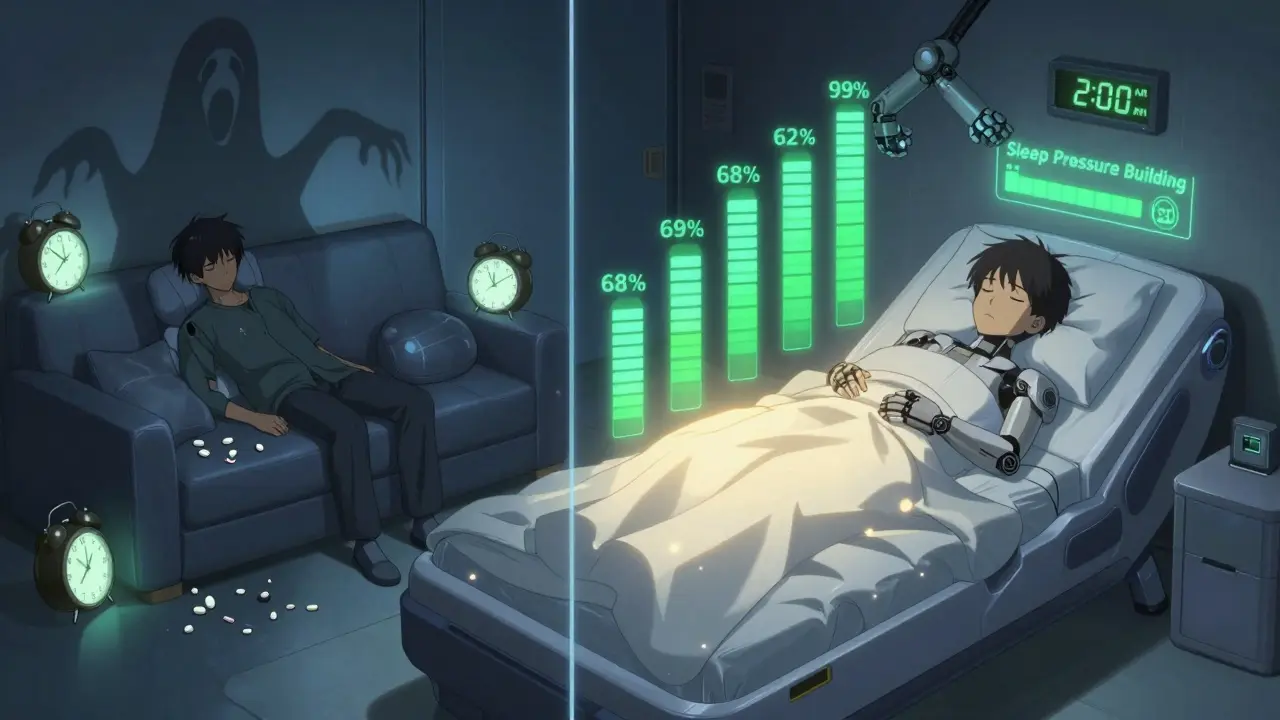
The core idea is simple: if you only allow yourself to be in bed for the amount of time you’re actually sleeping, your body will respond by making that sleep more efficient. For example, if your sleep diary shows you’re only getting 5 hours of sleep each night - even though you’re in bed for 8 - your therapist will tell you to limit your time in bed to just 5 hours. That means if you usually go to bed at 11 p.m. and wake at 7 a.m., you’d now go to bed at 2 a.m. and wake at 7 a.m.
This creates a mild, controlled sleep deprivation. Your brain responds by increasing sleep pressure, making you fall asleep faster and reducing nighttime awakenings. Over time, as your sleep efficiency (the percentage of time in bed actually spent sleeping) climbs above 85%, you gradually add 15-30 minutes to your time in bed each week. The goal? Reach 7-8 hours of consolidated, high-quality sleep - without medication.
According to the American Academy of Sleep Medicine, SRT is a guideline treatment - meaning it’s backed by strong evidence and recommended as a first-line option for chronic insomnia. Studies show it improves sleep efficiency by an average of 22-30%, cuts the time it takes to fall asleep by 50%, and reduces nighttime wakefulness significantly.
Step-by-Step: How to Start Sleep Restriction Therapy
Here’s how it works in practice:
- Track your sleep for 7 days. Use a sleep diary to record when you get into bed, when you fall asleep, when you wake up, and how many times you wake during the night. Don’t guess - write it down. This gives you your baseline average sleep time.
- Set your initial time-in-bed limit. Take your average sleep time (e.g., 5.5 hours) and set your time in bed to that number. If you sleep 5.5 hours on average, you get 5.5 hours in bed - no more. Pick a consistent wake-up time (e.g., 6 a.m.) and calculate your bedtime backward.
- Stick to the schedule - no exceptions. This is critical. No naps. No lying on the couch. No checking your phone. If you’re not sleepy, stay out of bed. Only go to bed when you’re truly ready to sleep.
- Wait for progress. After 3 straight nights with sleep efficiency above 85-90%, add 15-30 minutes to your time in bed. If efficiency drops below 85%, keep the same schedule until it improves.
- Continue until you hit 7-8 hours. Most people reach their ideal sleep time in 6-8 weeks. Some take longer. Patience and consistency are everything.
It’s not easy. The first 1-2 weeks are tough. You’ll feel tired during the day. But that’s the point - your body is relearning how to sleep. By week 3, most people notice their sleep becoming deeper and more restful.
Why It Works Better Than Sleeping Pills
Medications like benzodiazepines or z-drugs might help you fall asleep tonight, but they don’t fix the broken sleep cycle. In fact, they often make it worse over time. Studies show that 60-70% of people who use sleeping pills experience rebound insomnia when they stop - meaning they sleep even worse than before.
SRT, on the other hand, creates lasting change. A 2023 study from Sleepstation.org.uk found that 78% of people who completed SRT still had better sleep six months later. Compare that to just 32% for people who used medication. The difference? SRT retrains your brain. Medication just masks the problem.
It’s also more effective than sleep hygiene alone - things like avoiding caffeine or keeping a dark room. While those help, they don’t fix the core issue: too much time in bed awake. SRT combined with Stimulus Control Therapy (only using your bed for sleep and sex, getting up if you’re awake for more than 20 minutes) is the gold standard.
Who Should Avoid It - And Who Benefits Most
SRT isn’t for everyone. It’s not recommended if you:
- Have severe depression or untreated bipolar disorder - sleep restriction can worsen mood symptoms.
- Work night shifts or rotating shifts - your schedule doesn’t allow for fixed wake times.
- Have a medical condition that causes extreme fatigue - like sleep apnea or chronic fatigue syndrome.
- Are over 65 with very low baseline sleep time - your body may not tolerate the restriction safely.
But if you’re a healthy adult with chronic insomnia - especially if you’ve been lying awake for over 30 minutes most nights for months - SRT is one of the most effective tools you have. Research shows it works best for people who:
- Are willing to track their sleep honestly
- Can stick to a strict wake-up time (even on weekends)
- Are tired of relying on pills
- Want long-term results, not quick fixes
One Reddit user, SleepSeeker89, reported after 3 weeks: “My sleep efficiency jumped from 68% to 89%. I fall asleep in 15 minutes now - not 2 hours.” That’s not rare. It’s typical for people who follow the protocol.
Common Challenges and How to Get Through Them
Yes, it’s hard. Here’s what most people struggle with - and how to handle it:
- Daytime sleepiness: This is normal in the first 1-2 weeks. Don’t drive or operate machinery if you’re too tired. Plan quiet, low-risk activities. Most people say the fatigue fades after week 3.
- Wanting to nap: Napping kills sleep pressure. Even a 20-minute nap can undo your progress. If you’re exhausted, try lying down with your eyes closed - no screens, no reading. Just rest.
- Weekend slip-ups: This is the #1 reason SRT fails. If you go to bed at 1 a.m. on Friday and sleep until 9 a.m. on Saturday, you reset the whole process. Stick to your wake-up time every day - no exceptions.
- Fear of not sleeping: Anxiety makes insomnia worse. Remind yourself: you’re not failing if you’re awake. You’re building sleep pressure. The more you trust the process, the faster it works.
According to Sleep Education, 41% of people who quit SRT did so because they “cheated” on weekends. Don’t be one of them.

Tools and Support: Do You Need a Therapist?
You don’t need a therapist to do SRT - but it helps. A CBT-I-certified clinician can guide you, adjust your schedule, and keep you on track. In the U.S., there are about 1,200 certified providers. If you can’t find one, digital tools are a solid alternative.
Apps like Sleepio and CBT-i Coach (free through the VA) walk you through each step. A 2023 VA study found 72% satisfaction with CBT-i Coach. FDA-cleared apps like Somryst now deliver full CBT-I with SRT remotely, with 64% effectiveness in clinical trials.
Costs vary. In-person CBT-I can run $300-$2,500. Digital programs range from $50-$300. Many employers now offer CBT-I as part of wellness programs - check with your HR department. Insurance coverage is still limited - only 12 states require it as of early 2024 - but that’s changing fast.
What to Expect After 6 Months
Most people who complete SRT don’t just sleep better - they stop worrying about sleep. The anxiety fades because your body knows: bed = sleep. You’re no longer lying there counting minutes. You’re sleeping.
A 12-month follow-up study from Sleepstation.org.uk showed 68% of SRT completers maintained their improvements. For people who used medication? Only 29% did. SRT doesn’t wear off. It rewires your brain.
Dr. Colleen Carney, a leading sleep researcher, put it best: “SRT represents the most durable insomnia treatment available, with effects that continue to strengthen over time unlike pharmacological approaches.”
Final Thoughts: Is It Worth It?
If you’ve tried counting sheep, melatonin, chamomile tea, and sleeping pills - and nothing stuck - SRT might be the answer you’ve been waiting for. It’s not magic. It’s not easy. But it’s real. And it works.
You don’t need more sleep. You need better sleep. And that starts with spending less time in bed - not more.
Start with a week of sleep tracking. Be honest. Then decide: are you ready to reset your sleep?
How long does Sleep Restriction Therapy take to work?
Most people see improvements within 2-3 weeks, especially in how quickly they fall asleep. Full results - like sleeping 7-8 hours with minimal awakenings - usually take 6-8 weeks. Some need up to 3 months, depending on how long they’ve had insomnia.
Can I do Sleep Restriction Therapy on my own?
Yes, many people do. You’ll need a sleep diary, a consistent wake-up time, and discipline to avoid naps and weekend slip-ups. Digital tools like CBT-i Coach or Sleepio can guide you. But if you have anxiety, depression, or other health issues, working with a CBT-I-certified therapist is strongly recommended.
What if I can’t stick to the schedule?
If you miss a day or extend your time in bed, don’t panic. Just go back to your original schedule the next night. The key is consistency over time, not perfection. Most people slip up early on - the ones who succeed are the ones who keep going.
Will I feel exhausted all the time?
You’ll likely feel tired in the first 1-2 weeks - that’s normal. But as your sleep efficiency improves, your daytime energy will bounce back. Most people report feeling more alert after week 3, not less. The fatigue is temporary; the results are permanent.
Does SRT work for older adults?
Yes - especially for postmenopausal women with insomnia. A 2019 study found SRT improved sleep efficiency by 22.7% in this group, outperforming sleep meds. But if you’re over 65 and already sleeping less than 5 hours a night, talk to a doctor first. The restriction may be too extreme.
Can I combine SRT with melatonin or other supplements?
Melatonin can help with sleep timing, but it doesn’t fix the core issue SRT targets - too much time in bed awake. Some people use it briefly during the first week to help with sleep onset, but it’s not necessary. Avoid combining SRT with sleeping pills - they interfere with the process.
What’s the difference between SRT and Stimulus Control Therapy?
SRT limits how long you’re in bed to build sleep pressure. Stimulus Control Therapy (SCT) reassociates your bed with sleep by telling you: only go to bed when sleepy, get up if you’re awake for more than 20 minutes, and never use your bed for TV, work, or worrying. They’re usually done together - SRT handles the timing, SCT handles the association. Together, they form the core of CBT-I.
For those who’ve struggled with insomnia for years, SRT isn’t just another tip - it’s a reset. It’s the closest thing to a cure we have. And it doesn’t require a prescription. Just your commitment.





Stewart Smith
December 31, 2025 AT 23:58I tried this for 3 weeks after years of counting sheep. First week was brutal - felt like a zombie. Week 2? Still tired. Week 3? I fell asleep in 12 minutes. No pills. No magic. Just discipline. Now I sleep 7 hours straight. Best decision I ever made.
Martin Viau
January 1, 2026 AT 10:28This is just sleep deprivation dressed up as therapy. In Canada, we call this 'sleep restriction' - in the US, it's called 'being too lazy to take a pill.' The real problem? People think they can outsmart biology with spreadsheets.
Robb Rice
January 3, 2026 AT 06:08I followed this exactly. Sleep diary. Wake at 6:30 a.m. no exceptions. No naps. Only got 5.2 hours average. Set limit to 5h15m. After 11 days, efficiency hit 89%. I'm not saying it's easy - I'm saying it works. And yes, I typed this with one hand because I'm too tired to use both. Worth it.
Harriet Hollingsworth
January 3, 2026 AT 07:11This is just another way for rich white guys to guilt-trip people who are tired because they work two jobs and raise kids alone. You think I have time to track my sleep? I’m lucky if I remember to brush my teeth.
Deepika D
January 5, 2026 AT 04:57Hey everyone, I'm Deepika from India and I've been helping people with sleep issues for over a decade. Let me tell you - this method is powerful but it's not just about timing. It's about mindset. You have to believe that your bed is sacred space. No scrolling. No worrying. No Netflix. Just stillness. When I taught this to my students in Mumbai, many said they cried the first week because they realized how much they'd been fighting sleep instead of surrendering to it. That’s the real shift. Not the numbers - the surrender.
Bennett Ryynanen
January 5, 2026 AT 07:27I did this. I didn’t believe it. I almost quit after day 4. But I stuck with it. Now I sleep like a baby. And no, I don’t need melatonin anymore. I don’t even want it. This isn’t a hack. It’s a rebirth. Stop overthinking it. Just do it.
Chandreson Chandreas
January 5, 2026 AT 15:48The body knows what it needs. We just forget how to listen. SRT isn’t about restriction - it’s about alignment. Like a plant that stops stretching toward fake light and finally turns toward the sun. 🌞 You’re not fighting sleep. You’re letting it come home.
Darren Pearson
January 6, 2026 AT 00:30While the empirical data supporting SRT is indeed compelling, one must acknowledge the methodological limitations of self-reported sleep diaries. The Hawthorne effect likely inflates compliance metrics. Furthermore, the generalizability to populations with comorbid psychiatric conditions remains underexplored in peer-reviewed literature. One wonders if this is merely behavioral placebo dressed in CBT-I nomenclature.
Retha Dungga
January 7, 2026 AT 14:12I think the government put this in the article to distract us from the real issue - the 5G towers are messing with our melatonin and they don’t want us to know 🤫📡
linda permata sari
January 9, 2026 AT 02:55I’m from Indonesia and I tried this with my mom who’s 72. She slept 4 hours a night. We did SRT. She cried the first week. But now? She wakes up at 5:30 a.m. and makes tea like it’s a ritual. She says, 'My bed is my temple now.' I cried too. Not because it worked - because I finally understood what rest means.
Brandon Boyd
January 9, 2026 AT 08:34Look, if you’re reading this and you’ve been up for 3 hours again - I see you. I’ve been there. The first week feels like punishment. But here’s the secret: you’re not failing. You’re building. Every minute you’re awake in bed? That’s your brain learning: this isn’t a lounge. This is a sleep zone. Keep going. You’ve got this.
Frank SSS
January 10, 2026 AT 09:34I did this. I hated it. I cheated on weekends. I went back. I did it again. Took me 10 weeks. Now I sleep 7.5 hours. But here’s the thing - I still wake up at 3 a.m. sometimes. And I don’t panic. I just get up, sit in the dark, breathe, and wait. Because now I know - it’s not about forcing sleep. It’s about trusting it.
Paul Huppert
January 11, 2026 AT 05:02I’ve been doing this for 6 weeks. My sleep efficiency went from 61% to 88%. I didn’t even realize how much I was dreading bedtime until I stopped dreading it.
Hanna Spittel
January 11, 2026 AT 18:16This is a cult. They don’t want you to know that Big Pharma paid them to make you feel guilty for taking melatonin. 😈💊
Brady K.
January 13, 2026 AT 17:08You think this is hard? Try being a sleep researcher watching people quit after week 2 because they ‘can’t handle the fatigue.’ Fatigue isn’t the enemy. The belief that you need 8 hours of sleep to be human? That’s the real disease. SRT doesn’t fix sleep - it fixes your delusion about sleep. And honestly? That’s the only cure that lasts.