
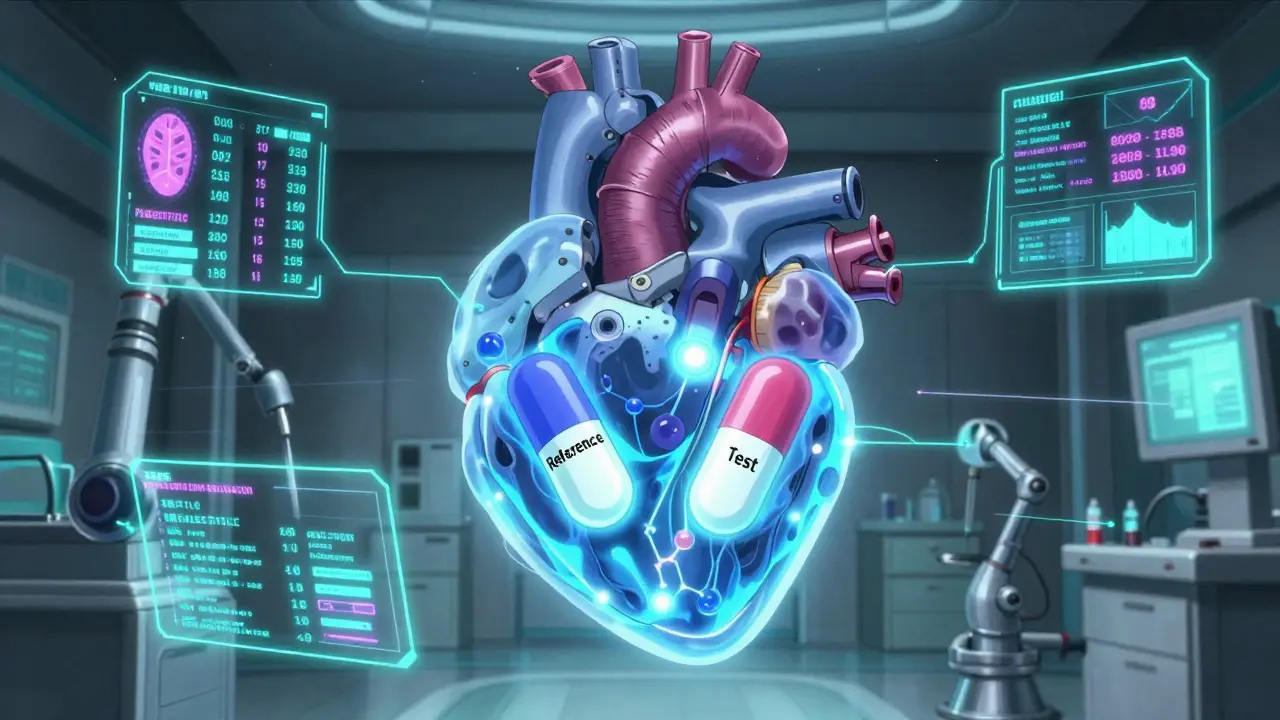
When two drugs are called "bioequivalent," it doesn’t just mean they contain the same active ingredient. It means they deliver that ingredient to your body in the same way-same speed, same amount, same duration. For decades, this was proven using a simple method: give 24 to 48 healthy volunteers both versions of a drug in a crossover study, draw blood every 15 to 30 minutes for hours, and compare the average exposure. But what if the drug is meant for elderly patients with kidney problems? Or children? Or people taking five other medications? That traditional method doesn’t work. That’s where population pharmacokinetics comes in.
Why Traditional Bioequivalence Falls Short
Traditional bioequivalence studies rely on healthy volunteers. They’re tightly controlled, with fixed dosing times and frequent blood draws. The goal? Show that the test drug’s AUC (total exposure) and Cmax (peak concentration) fall within 80-125% of the reference drug. Simple. Clean. But it’s also unrealistic. Real patients aren’t healthy 25-year-olds. They’re 72-year-olds with diabetes. They’re pregnant women. They’re people on dialysis. Their bodies process drugs differently. Weight, age, liver function, kidney clearance, even genetics-all these things change how a drug behaves. A drug that’s perfectly bioequivalent in healthy volunteers might be too strong or too weak in a real patient population. That’s why regulators started looking for better ways.What Population Pharmacokinetics Actually Does
Population pharmacokinetics, or PopPK, doesn’t need perfect data. It thrives on messy, real-world data. Instead of 48 blood samples per person, it uses 2 or 3. Instead of healthy volunteers, it uses patients from actual clinical trials. It takes data from hundreds of people with different body weights, ages, kidney function, and co-medications-and builds a model that shows how all those factors affect drug levels. Think of it like this: if you tried to predict how fast a car goes based only on its engine size, you’d miss a lot. PopPK looks at engine size, tire pressure, road conditions, driver weight, even the weather. It finds patterns in the noise. The math behind it is nonlinear mixed-effects modeling. It has two layers: one for how each person responds individually, and another for how the whole group behaves on average. It doesn’t assume everyone is the same. It assumes variation is normal-and it quantifies it.How PopPK Proves Equivalence
To prove two drugs are equivalent using PopPK, you don’t just compare average exposure. You look at variability. Let’s say Drug A and Drug B are both extended-release tablets. In a traditional study, both might show the same average AUC. But what if Drug A has a 40% variability in exposure across patients, while Drug B only has 15%? That’s a problem. For a drug with a narrow therapeutic window-like warfarin or cyclosporine-40% variability could mean some patients overdose and others get no benefit. PopPK catches this. Regulators now use PopPK to answer three key questions:- Is the exposure difference between formulations within an acceptable range across all subgroups?
- Are the sources of variability (like kidney function or weight) predictable and manageable?
- Does the model show that dose adjustments based on patient factors can maintain consistent exposure?

Where PopPK Shines: Real Examples
One of the biggest wins for PopPK is in special populations. Take neonates. You can’t draw 10 blood samples from a premature baby. Ethically, you can’t. But PopPK lets you use sparse data from hundreds of infants across multiple hospitals. A 2020 study used PopPK to prove equivalence between two formulations of vancomycin in preterm infants. The model showed both drugs delivered similar exposure across birth weights and gestational ages. No one had to endure painful, repeated blood draws. Another example: biosimilars. These are complex biologic drugs-like antibodies for cancer or autoimmune diseases. Traditional bioequivalence studies are nearly impossible. The molecules are too large, too sensitive, and too expensive to test in healthy volunteers. PopPK became the standard. The FDA approved multiple biosimilars for infliximab and rituximab based almost entirely on PopPK analyses. Even in generics. A Merck case study from 2021 showed that using PopPK reduced the need for follow-up clinical trials by 35% when proving equivalence for a drug used in patients with moderate kidney impairment. They didn’t need a new trial. They used data they already had.The Tools and the Talent
PopPK isn’t something you do with Excel. It needs specialized software. NONMEM has been the industry standard since 1980. Monolix and Phoenix NLME are also common. These tools run complex statistical models that can take hours-or days-to compute. But the bigger challenge isn’t the software. It’s the people. You need pharmacometricians-specialists who understand both pharmacology and advanced statistics. Training takes 18 to 24 months. And even then, model-building is part art, part science. A common mistake? Overcomplicating the model. Adding too many covariates-like age, weight, creatinine, liver enzymes, drug interactions-can make the model fit the data perfectly but fail to predict anything new. The FDA says models should be as simple as possible, but no simpler. Another pitfall? Poor data collection. If a clinical trial wasn’t designed with PopPK in mind-sparse sampling, inconsistent timing, missing covariates-it’s often unusable. That’s why leading companies now build PopPK planning into Phase 1 trials, not after.Regulatory Acceptance: FDA, EMA, and Beyond
The FDA has been the biggest driver. Their 2022 guidance was a game-changer. It didn’t just say “PopPK is allowed.” It laid out exactly what they expect: minimum sample sizes (40+ participants), how to report variability, how to validate models, and what covariates to include. The EMA is more cautious. They accept PopPK for dose optimization, but still often require traditional bioequivalence studies for approval. Still, their 2014 guidelines clearly state that PopPK can “account for variability in terms of patient characteristics”-a major shift. Japan’s PMDA adopted similar standards in 2020. And in 2023, the FDA launched a pilot program to use PopPK for post-approval equivalence monitoring-meaning they might use real-world data years after a drug is on the market to check if generic versions still behave the same.
Challenges and Criticisms
PopPK isn’t magic. It has limits. First, it needs good data. If your trial only collected two blood samples and didn’t record patient weight, you’re stuck. Second, validation is messy. There’s no single standard for how to prove a model is “right.” Some use cross-validation. Others use simulation. Regulators still debate which is best. A 2023 survey of 200 pharmacometricians found that 65% said model validation was their biggest hurdle. And 42% said they couldn’t get enough quality data from trials designed without PopPK in mind. Some experts also warn that PopPK can mask small but important differences. If a drug has high variability to begin with-like phenytoin-PopPK might not detect a 10% difference in exposure that could still cause seizures or toxicity. And there’s the learning curve. Many regulatory reviewers still don’t understand PopPK. A submission might get rejected not because the science is wrong, but because the reviewer doesn’t know how to interpret it.The Future: Machine Learning and Global Harmonization
The next big leap is machine learning. A January 2025 study in Nature showed how AI models could detect non-linear relationships between drug exposure and patient factors that traditional PopPK models miss. For example, a drug might behave differently in obese patients with type 2 diabetes-something a linear model might overlook, but an AI could spot. The IQ Consortium is working on standardizing model validation by late 2025. That’s critical. Right now, a model accepted in the U.S. might be rejected in Europe because the validation approach was different. And the market is growing fast. The global pharmacometrics market is projected to hit $1.27 billion by 2029. Nearly all top pharmaceutical companies now have dedicated PopPK teams. Why? Because it saves time, money, and lives.Bottom Line: PopPK Is Changing How We Prove Drug Equivalence
Population pharmacokinetics isn’t replacing traditional bioequivalence. It’s expanding it. It’s giving regulators a way to prove equivalence not just for healthy volunteers, but for the real people who need the drug. It’s not easy. It’s not quick. But when done right, it means fewer unnecessary trials, faster access to generics, and safer dosing for vulnerable patients. For drugs with narrow therapeutic windows, for elderly patients, for children, for those with organ failure-PopPK isn’t just useful. It’s essential.What used to take years of clinical trials can now be answered with smart modeling and real-world data. That’s the future of drug equivalence-and it’s already here.



trudale hampton
March 21, 2026 AT 17:06This is actually one of those topics that doesn't get enough attention. I work in pharma and honestly, PopPK has saved us so much time and money. We used to run full bioequivalence studies for every generic version. Now we use sparse sampling and existing trial data. It's not perfect, but it's way more realistic. Especially for elderly or pediatric populations. Honestly, if regulators keep moving this way, we'll see generics hit the market faster without sacrificing safety.
Shaun Wakashige
March 22, 2026 AT 13:31lol so now we're using math to prove drugs work? 🤡
Jackie Tucker
March 23, 2026 AT 06:15Ah yes, the great PopPK delusion. You think modeling noise is science? Let me guess-you also believe in climate models that predict rain in 2050 based on a single data point from 1987. This isn't pharmacology. It's statistical theater. The FDA's 2022 guidance? More like a corporate lobbying victory disguised as regulatory progress. Real medicine doesn't need 18 months of training to tell if a pill works. It needs clinical outcomes. Not simulations.
Thomas Jensen
March 23, 2026 AT 22:18You ever wonder who controls the data? Who decides what covariates get included? What if the model is built on trials funded by the original manufacturer? PopPK looks fancy but it's just a black box that lets Big Pharma skip real testing. I've seen it. A drug gets approved because the model 'shows equivalence'-then three years later, patients start dropping like flies because the real-world variability was ignored. It's not science. It's a cover-up.
matthew runcie
March 23, 2026 AT 23:11Solid breakdown. I've worked with PopPK models and the key is simplicity. Too many people overfit. The FDA's 'as simple as possible, but no simpler' rule is spot on. Real-world data is messy, but if you focus on the most impactful covariates-weight, renal function, age-you get a model that actually predicts. No need for 12 variables. Three good ones do the job.
shannon kozee
March 25, 2026 AT 17:43Neonates example is the most compelling. You can't draw 10 blood samples from a preemie. Ethically impossible. PopPK made it possible to prove equivalence without harming them. That's not just efficient-it's humane.
Paul Cuccurullo
March 27, 2026 AT 11:20The future of pharmacology lies not in brute-force trials, but in intelligent modeling. This is the evolution of evidence-based medicine. We are moving from 'one size fits all' to 'precision dosing for real patients.' It’s not just about equivalence-it’s about equity. For the elderly, the ill, the children-PopPK ensures they aren’t left behind because they don’t fit the mold of a healthy 25-year-old volunteer. This is progress, and it’s long overdue.
Solomon Kindie
March 28, 2026 AT 20:03PopPK is just math porn. You build a model with 20 covariates and call it science. But when you validate it on real data it falls apart. And dont even get me started on the validation methods. Some use cross validation some use simulations some use voodoo. And the FDA? They accept whatever you submit as long as it looks fancy. I saw a submission once where they used age as a covariate but forgot to record sex. The model was still approved. Its a joke