
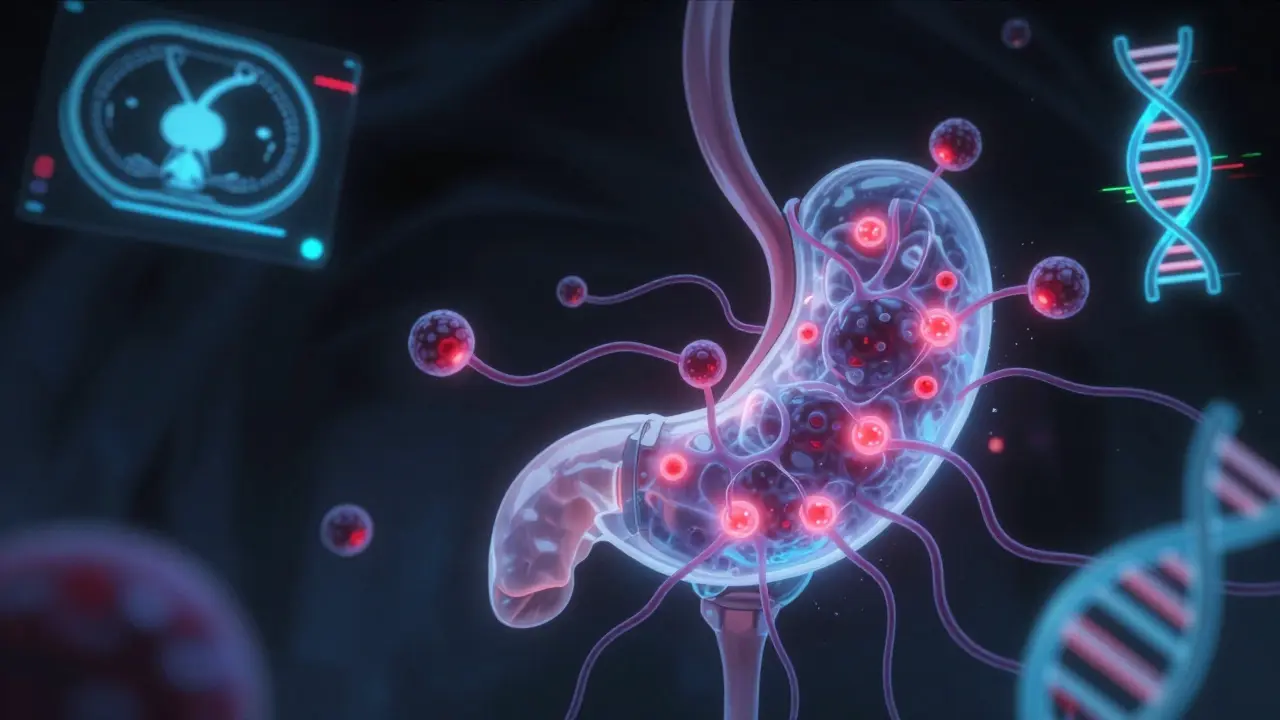
Most people don’t realize pancreatic cancer can be hiding in plain sight for months - or even years - before it’s found. The pancreas sits quietly behind your stomach, doing its job: making enzymes to digest food and hormones to control blood sugar. But when cancer starts there, it doesn’t shout. It whispers. And by the time you hear it, it’s often too late.
Why Pancreatic Cancer Is So Dangerous
Pancreatic cancer kills about 52,000 people in the U.S. every year. That’s more than breast cancer. More than cervical cancer. More than liver cancer. And yet, most people have never heard of it until someone they know is diagnosed. Why? Because it’s hard to catch early.The 5-year survival rate for all stages combined is just 12%. That number sounds brutal, but here’s the twist: if the cancer is caught before it spreads - and only about 1 in 5 cases are - the survival rate jumps to 44%. That’s the difference between a death sentence and a chance to live.
Most cases are found at stage III or IV. That means the tumor has either grown into nearby organs or spread to the liver, lungs, or other parts of the body. By then, surgery is often no longer an option. And that’s why knowing the early signs matters more than ever.
Early Symptoms You Can’t Ignore
These aren’t the kind of symptoms you can brush off as “just stress” or “getting older.” They’re subtle, but they show up together - and they don’t go away.- Unexplained weight loss - Losing 10 pounds or more without trying? That’s not normal. About 60% of people with pancreatic cancer lose weight before diagnosis. It’s not from dieting. It’s from the cancer stealing your body’s ability to absorb nutrients.
- Abdominal or back pain - A dull ache in your upper belly that moves to your back? That’s a classic sign. The tumor presses on nerves and organs. It’s often mistaken for muscle strain or digestive issues.
- Jaundice - Yellow skin, yellow eyes, dark urine, pale stools. This happens when the tumor blocks the bile duct. The bile builds up in your blood, turning your skin and eyes yellow. It’s not just cosmetic - it’s a red flag. About 70% of pancreatic head tumors cause this.
- New-onset diabetes - If you’ve never had diabetes before, and now your blood sugar is high, get checked. Research shows 80% of pancreatic cancer patients develop diabetes within 18 months of the cancer starting. In many cases, the diabetes appears just 6 months before diagnosis. Your body isn’t suddenly failing - your pancreas might be failing.
- Loss of appetite and nausea - Food doesn’t taste right. You feel full after eating a bite. You get sick after meals. These aren’t just “bad days.” They’re signs your digestive system is being disrupted.
- Changes in stool - Greasy, floating, light-colored stools that smell awful? That’s your body saying it can’t digest fat anymore. Bile isn’t reaching your intestines. This happens in about 30% of cases.
- Depression or anxiety - This one surprises people. A 2018 study found that nearly half of pancreatic cancer patients had depression or anxiety months before physical symptoms appeared. It’s not just emotional stress. The cancer releases chemicals that affect brain chemistry. If you’ve been feeling “off” emotionally for no reason, it’s worth mentioning to your doctor.
Here’s the hard truth: 68% of patients had at least three of these symptoms before they were diagnosed. And the average delay between first noticing symptoms and getting a diagnosis? Over four months. Too many are told they have IBS, gallstones, or acid reflux. They’re sent home with antacids. Meanwhile, the cancer grows.

Why It’s So Hard to Detect Early
The pancreas is tucked deep behind your stomach. You can’t feel a tumor there with a physical exam. There’s no routine blood test like a mammogram or colonoscopy for the general public. That’s why screening isn’t offered to everyone.The only reliable way to find early pancreatic cancer is through imaging - CT scans, MRIs, or endoscopic ultrasounds. But these are expensive, and they’re not perfect. A CT scan can miss tumors smaller than 2 centimeters. Blood tests like CA 19-9 are helpful for tracking advanced disease, but they catch less than half of early cases.
Right now, screening is only recommended for people at high risk:
- Those with inherited gene mutations like BRCA1, BRCA2, or Lynch syndrome
- People with hereditary pancreatitis
- Those with a strong family history - two or more close relatives with pancreatic cancer
For everyone else, the best defense is awareness. If you have unexplained weight loss, new diabetes, or jaundice - don’t wait. Push for imaging. Ask: “Could this be pancreatic cancer?”
Treatment Advances That Are Changing Outcomes
Ten years ago, metastatic pancreatic cancer meant months to live. Today, some patients are living years.Surgery is still the only chance for a cure. The Whipple procedure - removing part of the pancreas, duodenum, and sometimes part of the stomach - is complex, but it works. For early-stage tumors, 20-25% of patients survive five years after surgery.
But surgery isn’t always possible at diagnosis. That’s where neoadjuvant therapy comes in. Doctors now give chemotherapy - sometimes with radiation - before surgery to shrink tumors. One combo, FOLFIRINOX, has turned borderline tumors into resectable ones in more than half of patients.
For those who can’t have surgery, treatment has improved dramatically:
- Modified FOLFIRINOX - In a major 2022 trial, patients on this regimen lived an average of 54.4 months - more than four years - compared to 20 months with older treatments.
- Olaparib - For patients with BRCA gene mutations, this targeted drug can delay cancer progression by nearly eight months. It’s not a cure, but it buys time.
- Pembrolizumab - Works wonders for the rare 3-4% of patients whose tumors have MSI-H/dMMR mutations. These patients often see dramatic responses.
And now, researchers are testing liquid biopsies - blood tests that look for cancer DNA. Johns Hopkins developed PancreaSeq, which detected early-stage cancer with 95% accuracy in high-risk groups. Another test, being studied in the DETECTA trial, is already showing 85% accuracy in spotting cancer signals in blood.

What’s Next? The Hope on the Horizon
The future of pancreatic cancer care is personalization. Instead of treating everyone the same, doctors are starting to match treatments to the exact genetic profile of the tumor.AI is helping too. Google Health’s LYNA algorithm can spot cancer cells on tissue slides with 99.3% accuracy - faster and more consistently than human pathologists. And microbiome studies are showing that gut bacteria patterns differ in pancreatic cancer patients. That could lead to a simple stool test one day.
The National Cancer Institute has set a goal: reduce pancreatic cancer deaths by 25% by 2030. That’s ambitious. But with better screening tools, smarter treatments, and more awareness, it’s not impossible.
What You Can Do Now
You can’t control your genes. But you can control what you pay attention to.- If you’re over 50 and have new-onset diabetes, ask your doctor about pancreatic cancer screening - especially if you have a family history.
- If you’re losing weight without trying, don’t assume it’s aging. Get blood tests and imaging.
- If you have jaundice, don’t wait. See a specialist immediately.
- If you’ve been feeling depressed for no reason and have other symptoms, mention it. Mental health changes can be early signs.
Pancreatic cancer doesn’t care how healthy you are. It doesn’t care if you exercise or eat well. It’s sneaky. But it’s not invisible. The more people know the signs, the more lives can be saved.
Can pancreatic cancer be cured if caught early?
Yes - but only if it hasn’t spread beyond the pancreas. Surgery to remove the tumor offers the only real chance for a cure. About 44% of patients diagnosed at the localized stage survive five years or more. That’s why catching it early is critical.
Is there a blood test for pancreatic cancer?
There’s no standard blood test for the general population. CA 19-9 is used to monitor advanced disease, but it misses early-stage cancer in up to 70% of cases. New blood tests that detect tumor DNA are in clinical trials and show promise - one reached 85% accuracy in early testing. These aren’t available yet for routine use.
Does new-onset diabetes mean I have pancreatic cancer?
Not necessarily. But if you’re over 50 and develop diabetes without risk factors like obesity or family history, it’s a red flag. About 80% of pancreatic cancer patients develop diabetes within 18 months of diagnosis. Doctors now consider new-onset diabetes in older adults as a potential warning sign - and may recommend imaging if other symptoms are present.
Who should be screened for pancreatic cancer?
Screening is only recommended for people at high risk: those with inherited gene mutations (like BRCA), hereditary pancreatitis, or a family history of pancreatic cancer in two or more close relatives. Screening usually involves annual MRI or endoscopic ultrasound starting at age 50 - or 10 years before the earliest case in the family.
What are the survival rates for pancreatic cancer today?
Overall, the 5-year survival rate is 12%. But that number hides big differences: for localized cancer (not spread), it’s 44%. For cancer that’s spread to nearby areas, it’s 15%. For distant spread, it’s just 3%. Thanks to new treatments like FOLFIRINOX and targeted therapies, median survival for metastatic disease has jumped from 6 months in 2000 to 12-15 months today - and some patients live much longer.
Can lifestyle changes prevent pancreatic cancer?
You can’t prevent it completely, but you can lower your risk. Smoking is the biggest avoidable cause - it doubles your risk. Obesity and chronic pancreatitis also increase risk. Avoiding tobacco, maintaining a healthy weight, and limiting alcohol can help. But even healthy people get it. That’s why awareness of symptoms matters more than prevention.




Alexandra Enns
January 26, 2026 AT 02:53Let me tell you something-this whole ‘early detection’ thing is a scam pushed by Big Pharma to sell more CT scans. I’ve seen three people in my town die from this, and guess what? All of them got ‘advised’ to get expensive imaging after their symptoms showed up. Meanwhile, the real issue is that our healthcare system only cares when you’re already dying. Why isn’t there a $10 blood test for everyone? Because it wouldn’t make anyone rich. Wake up.
Marie-Pier D.
January 27, 2026 AT 02:55I’m so glad someone finally put this out there in plain language 😭 My aunt went through this last year-lost 20 lbs, got ‘IBS’ for 6 months, then jaundice hit and BOOM-stage IV. She didn’t even know what the pancreas did. We need to teach this in high school health class. Please share this with your moms, your dads, your friends who always say ‘I’m just tired.’ It could save someone. 💜
Phil Maxwell
January 28, 2026 AT 01:25Interesting post. I had unexplained weight loss last year and got a CT scan out of nowhere-turns out it was just a weird thyroid thing. But I’m glad this info’s out there. I’ll keep an eye out for my dad-he’s 62 and just got diabetes. Might push him to get checked.
Shelby Marcel
January 29, 2026 AT 11:01wait so new diabeties = cancer?? i thought that was just from eating too much sugar?? like im confused now. also my uncle had this and they said his stool looked like oil paint?? wtf??
Karen Conlin
January 29, 2026 AT 18:45Listen. I’m a nurse in Chicago. I’ve seen this play out too many times. People get told ‘it’s stress’ or ‘you’re getting older.’ Meanwhile, the cancer is eating their insides like a silent ghost. The symptoms listed? They’re real. And if you’re over 50 and losing weight without trying? Don’t wait for your next checkup. Go to the ER. Say, ‘I’m worried about pancreatic cancer.’ Say it out loud. It’s not dramatic-it’s survival. And yes, depression before physical symptoms? Real. Your body’s screaming. You just have to learn how to listen.
asa MNG
January 30, 2026 AT 23:54bro i had all these symptoms last year and my dr just gave me omeprazole 😭 i was depressed for 8 months too, thought i was just broken. now i’m in remission after FOLFIRINOX and olaparib but like… why did it take 11 months?!? why did no one tell me?? also i’m still mad at my ex for ghosting me during chemo 🤬
Sushrita Chakraborty
February 1, 2026 AT 05:46It is imperative to emphasize that the early detection of pancreatic cancer remains a critical public health priority. The statistical data presented herein are both compelling and alarming. In particular, the correlation between new-onset diabetes and pancreatic neoplasia, as supported by peer-reviewed literature, warrants immediate clinical consideration. I urge all healthcare providers to integrate these symptoms into their differential diagnosis protocols, particularly for patients over the age of fifty, with no prior metabolic history. Early intervention can yield a fourfold increase in five-year survival rates.
Sawyer Vitela
February 3, 2026 AT 01:4244% survival if caught early? That’s still a 56% death rate. And FOLFIRINOX kills more people than it saves. You’re selling hope, not facts.
Shanta Blank
February 4, 2026 AT 19:09OMG. I just read this and I’m SCREAMING. This is the most important post I’ve seen all year. I’ve been telling my family for years that ‘if you feel weird, don’t ignore it’-but NOBODY listens. Now I’m sending this to everyone. My cousin’s mom died in 3 months. She was told it was ‘gallbladder.’ I’m crying. I’m shaking. I’m posting this on Facebook, Instagram, TikTok, and my mom’s WhatsApp group. If this saves ONE life, it’s worth it. 🙏🔥