

If you're taking multiple medications for chronic conditions like diabetes, high blood pressure, or asthma, you might have felt overwhelmed. Maybe you’ve lost track of which pill to take when, worried about side effects, or wondered if you’re paying too much. You’re not alone. That’s where Medication Therapy Management comes in - a free, personalized service designed to help you get the most out of your meds and avoid dangerous mistakes.
What Exactly Is Medication Therapy Management (MTM)?
Medication Therapy Management, or MTM, is a service offered by your Medicare Part D drug plan that connects you with a pharmacist who spends time with you - one-on-one - to review every medication you take. It’s not about filling prescriptions. It’s about making sure all your pills work together safely, effectively, and affordably.
The U.S. government requires all Medicare Part D plans to offer MTM to qualifying members. This isn’t optional. It’s built into your coverage because research shows it works. Patients who use MTM are less likely to end up in the hospital from bad drug reactions, take their meds correctly, and save money on unnecessary prescriptions.
Who Qualifies for MTM Services?
You don’t have to ask for it - if you qualify, your plan will reach out. To be eligible, you must meet all three of these criteria:
- You take 8 or more Medicare Part D prescription medications
- You have 3 or more chronic health conditions (like heart disease, diabetes, COPD, depression, or kidney disease)
- Your annual drug costs exceed $4,430 (as of 2026)
These numbers aren’t arbitrary. They’re based on data showing people who meet this profile are at the highest risk for medication errors, dangerous interactions, or spending too much. If you’re close but don’t quite hit the threshold, some plans may still invite you - check with your insurer.
What Happens During a Medication Review?
The heart of MTM is the Comprehensive Medication Review (CMR). This is a 30- to 60-minute phone or video call with a pharmacist who specializes in medications. They’ll ask you to list everything you take - even over-the-counter pills, vitamins, herbs, and supplements. Many people forget these, but they can cause serious problems when mixed with prescription drugs.
During the review, your pharmacist will:
- Check for duplicate medications - yes, sometimes two doctors prescribe the same thing
- Spot dangerous interactions - like blood thinners mixed with certain painkillers or herbal teas
- Find cheaper alternatives - maybe a generic version cuts your cost by 80%
- Identify pills you might not even need anymore
- Explain how and when to take each one - no more guessing
You’ll walk away with two important documents:
- Personal Medication Record (PMR) - a complete, updated list of everything you take, in plain language
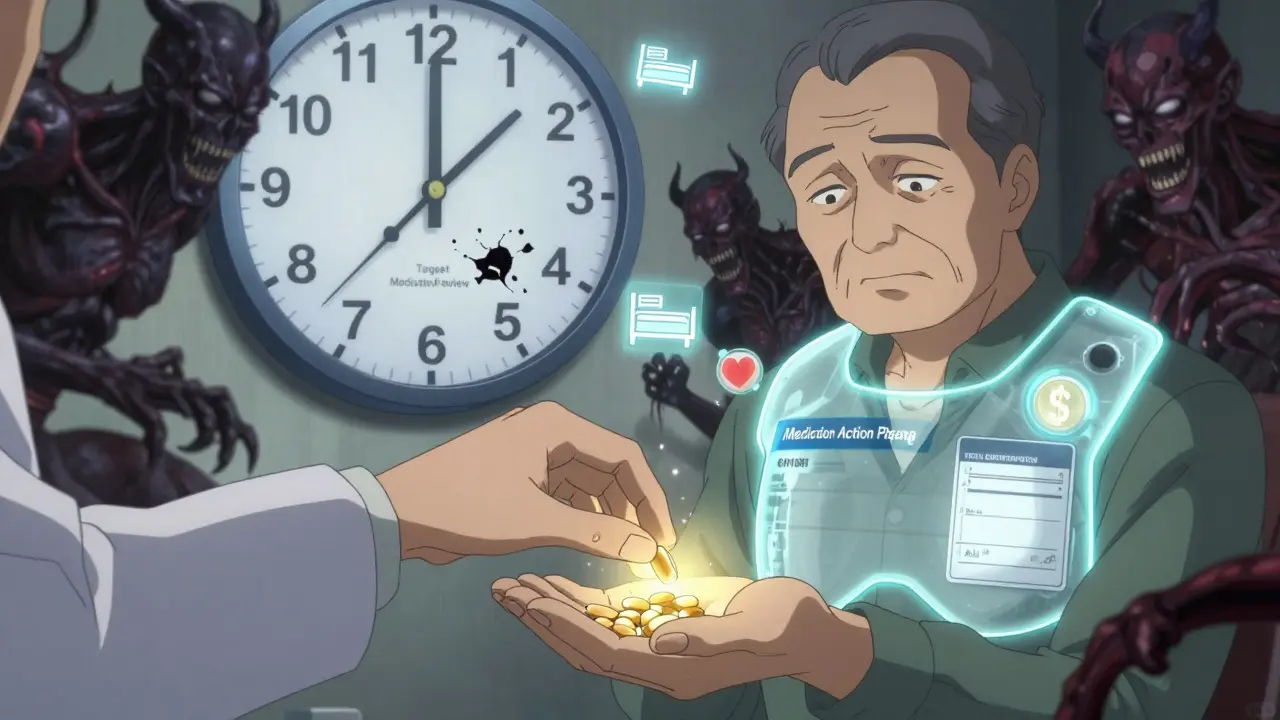
- Medication Action Plan - a simple to-do list with clear steps: “Start taking this pill with food,” “Call your doctor about this side effect,” “Switch to the lower-cost brand”
What About Follow-Ups?
One review isn’t enough. Your meds change. Your health changes. That’s why MTM includes Targeted Medication Reviews (TMRs) every few months. These are shorter check-ins - usually triggered if you’ve had a hospital visit, started a new drug, or if your pharmacist notices something off in your refill patterns.
For example, if you refill your blood pressure med only twice in six months, your pharmacist might call to ask if you’re skipping doses. If you’re having nausea after your new diabetes pill, they’ll talk to your doctor about switching. These aren’t random calls - they’re proactive safety checks.
Why Pharmacists? Why Not Just Ask Your Doctor?
Your doctor is busy. They might see you for 10 minutes and prescribe three new drugs. Pharmacists? They’re the medication experts. They spend years studying how drugs interact, how the body processes them, and how to make them safer.
Think of it this way: your doctor treats your condition. Your pharmacist treats your meds. They’re trained to spot what others miss - like how your cholesterol pill and your thyroid med cancel each other out, or how your nightly sleep aid makes your morning blood pressure med less effective.
And unlike doctors, pharmacists don’t charge you extra. MTM is covered 100% by your Medicare Part D plan. No copay. No deductible. No surprise bills.
Real Impact: What Patients Say
People who’ve used MTM report feeling less anxious and more in control. One 72-year-old woman with diabetes, heart failure, and arthritis said she was taking 14 different pills - and didn’t know why she was on half of them. After her CMR, her pharmacist found three duplicates, two that weren’t helping, and a cheaper version of her insulin. She cut her monthly drug bill by $180 and stopped feeling dizzy all the time.
Another man with COPD and depression was mixing his antidepressant with a common cold medicine - a combo that can cause dangerous heart rhythms. His pharmacist flagged it immediately and suggested a safe alternative. He didn’t even realize there was a risk.
These aren’t rare cases. Studies show MTM reduces hospital stays by up to 30% in high-risk patients and saves Medicare billions annually by preventing avoidable complications.
What If You Can’t Talk on the Phone?
If you’re not comfortable with phone calls, or if you have trouble hearing or remembering details, you can bring someone with you. A family member, caregiver, or friend can join the CMR or TMR - even if they’re not listed on your plan. They can take notes, ask questions, and help you follow the action plan.
Some plans even offer in-person reviews at local pharmacies. Ask your plan if they have a partner pharmacy near you that offers face-to-face MTM sessions.

What Doesn’t MTM Do?
MTM won’t give you new prescriptions. It won’t refill your meds. It won’t replace your doctor. It’s not a substitute for emergency care or regular checkups.
It also won’t change your treatment goals. If your doctor says you need a certain drug for your condition, your pharmacist won’t tell you to stop. Instead, they’ll help you take it safely, affordably, and consistently.
MTM is a support system - not a decision-maker. You still have the final say in your care. The pharmacist’s job is to give you the facts so you can make smarter choices.
How to Get Started
You don’t need to apply. If you qualify, your Medicare Part D plan will mail or email you an invitation. It usually comes once a year. If you haven’t heard anything and think you might qualify, call your plan’s customer service line. Ask: “Am I eligible for Medication Therapy Management?”
Once you’re invited, pick a time that works. Don’t wait. The sooner you do it, the sooner you’ll know if you’re taking the right meds, at the right dose, for the right reason - and paying the right price.
What’s Next for MTM?
Right now, MTM is tied to Medicare Part D. But it’s starting to spread. Some Medicaid programs and private insurers are launching their own versions. States like Tennessee are using MTM in community clinics to help low-income patients manage complex drug regimens.
The goal? Make this service standard for anyone on multiple medications - not just seniors on Medicare. Because if you’re taking five or more pills a day, you deserve this kind of support.





Curtis Younker
January 26, 2026 AT 20:38Man, I wish I’d known about this years ago. My grandma was taking 12 different pills and didn’t even know half of them were for stuff she didn’t have anymore. She kept saying she felt ‘weird’-turns out it was a combo of her blood pressure med and that ginseng tea she swore by. After her CMR, they cut her down to 6, saved her $200 a month, and she stopped falling in the bathroom. Pharmacists are the real MVPs. Why do we treat them like glorified cashiers?
Shweta Deshpande
January 27, 2026 AT 16:21This is honestly one of the most important things I’ve read all year. I’m from India and we don’t have anything like this-people just buy meds off the street or take whatever the doctor scribbles. My uncle died because no one checked if his diabetes pills clashed with his heart med. If this service existed where I’m from, he’d still be here. Please, someone push for this in developing countries. It’s not a luxury-it’s survival.
Shawn Raja
January 28, 2026 AT 22:54Let’s be real-this is the only thing Medicare’s done right in the last 20 years. We’ve turned healthcare into a casino where the house always wins… except here, the pharmacist is the dealer who actually gives you the winning hand. And yet, nobody talks about it. Why? Because if people knew they could get free, expert, personalized drug advice without begging their doctor between appointments, the whole ‘doctor as god’ myth would crumble. And nobody wants that.
Karen Droege
January 30, 2026 AT 18:17OMG YES. I’m a pharmacist in Portland and I’ve been begging my clinic to expand MTM beyond Medicare. My patients on Medicaid? On 8+ meds? They’re drowning. I’ve had 80-year-olds cry because they thought the dizziness was ‘just aging.’ Turns out it was a drug interaction with their OTC sleep aid and their antidepressant. I don’t get paid extra for this. I do it because it’s right. If you’re on 5+ meds, you deserve this. Period. Let’s make it universal. Not just for seniors. For everyone. We’re not just pills-we’re humans with bodies that don’t read prescriptions.
Dan Nichols
January 31, 2026 AT 05:40MTM sounds great until you realize it’s just a cost-cutting tool disguised as care. Pharmacies get paid per review so they’re incentivized to cut meds not because they’re unnecessary but because they’re expensive. And who’s to say the pharmacist isn’t just following a script from the insurance company? I’ve seen it happen. They’ll drop your statin because it’s pricey even if your LDL’s through the roof. Don’t be fooled by the warm fuzzies.
Renia Pyles
February 1, 2026 AT 04:06So let me get this straight-my insurance is going to call me out of the blue and say ‘Hey, you’re taking too many pills, let’s have a chat’? And I’m supposed to believe they care? This is just another way to get me to stop taking meds so they don’t have to pay for them. My doctor won’t even return my calls but suddenly a pharmacist is my new best friend? No thanks. I’ll keep my pills and my distrust.
Geoff Miskinis
February 2, 2026 AT 20:30One must acknowledge the structural absurdity of a system that requires 8 prescriptions, 3 chronic conditions, and $4,430 in annual spend before offering basic pharmacological hygiene. One might argue this is not ‘management’ at all, but triage masquerading as beneficence. The fact that such a service exists only as a compliance checkbox under Part D reveals the pathology of American healthcare: intervention is only mandated when the patient has become statistically inconvenient. The real tragedy isn’t the polypharmacy-it’s the indifference that waits until the crisis to intervene.
Jessica Knuteson
February 4, 2026 AT 19:08MTM is a bandaid on a gunshot wound. You think a 45 minute phone call fixes systemic neglect? Doctors prescribe like they’re playing bingo. Pharmacies refill like robots. Insurance denies like it’s their job. This service doesn’t change anything. It just makes people feel better about the system that broke them.
Simran Kaur
February 5, 2026 AT 09:02I’m from India and my mom takes 7 meds. No one ever asked if they interacted. She started feeling dizzy last month. We went to the pharmacy and the guy just handed her another pill. I cried. I wish someone had told us about MTM. I’m going to start a WhatsApp group for Indian seniors here in the US-teach them how to ask for this. We don’t need to wait for permission to care for each other.
Neil Thorogood
February 6, 2026 AT 16:24Just had my CMR. My pharmacist found I was taking two different versions of the same blood pressure med. I didn’t even know. Also cut my monthly bill by $160. And yes, I cried. Not because I’m emotional (though I am) but because someone finally looked at me like a person, not a claim number. 🥹💊 Thank you, pharmacist. You’re the unsung hero of modern medicine. Let’s make this mandatory for everyone on 5+ meds. No exceptions.
Allie Lehto
February 7, 2026 AT 07:38why do we let corporations decide who gets care? if you have 3 chronic illnesses and spend over 4430 a year you get help? what if you have 2 illnesses but take 10 pills? what if you’re poor but not poor enough? this system is broken. i hate that my health is a math problem. i hate that i have to be a statistic to be seen. but thank you for this. even if it’s flawed, it’s something. i’m going to call my plan today. i deserve this. we all do.
Napoleon Huere
February 8, 2026 AT 17:45Think about this: every time a pharmacist reviews your meds, they’re not just checking for interactions-they’re listening. To the fear behind the question, ‘Is this pill making me crazy?’ To the shame of forgetting to take it. To the loneliness of managing a dozen conditions alone. This isn’t just medicine. It’s human connection disguised as protocol. And in a world that treats the elderly like outdated software, that’s revolutionary. Maybe the future of healthcare isn’t AI or apps-it’s a pharmacist with patience and a checklist.
Aishah Bango
February 10, 2026 AT 09:21You people are so naive. This is just another way for Big Pharma to push generics and get people off their brand-name drugs. They don’t care if you live or die-they care if your meds are cheaper. I’ve seen the scripts they push. It’s not about safety. It’s about profit. Don’t fall for the feel-good story.