
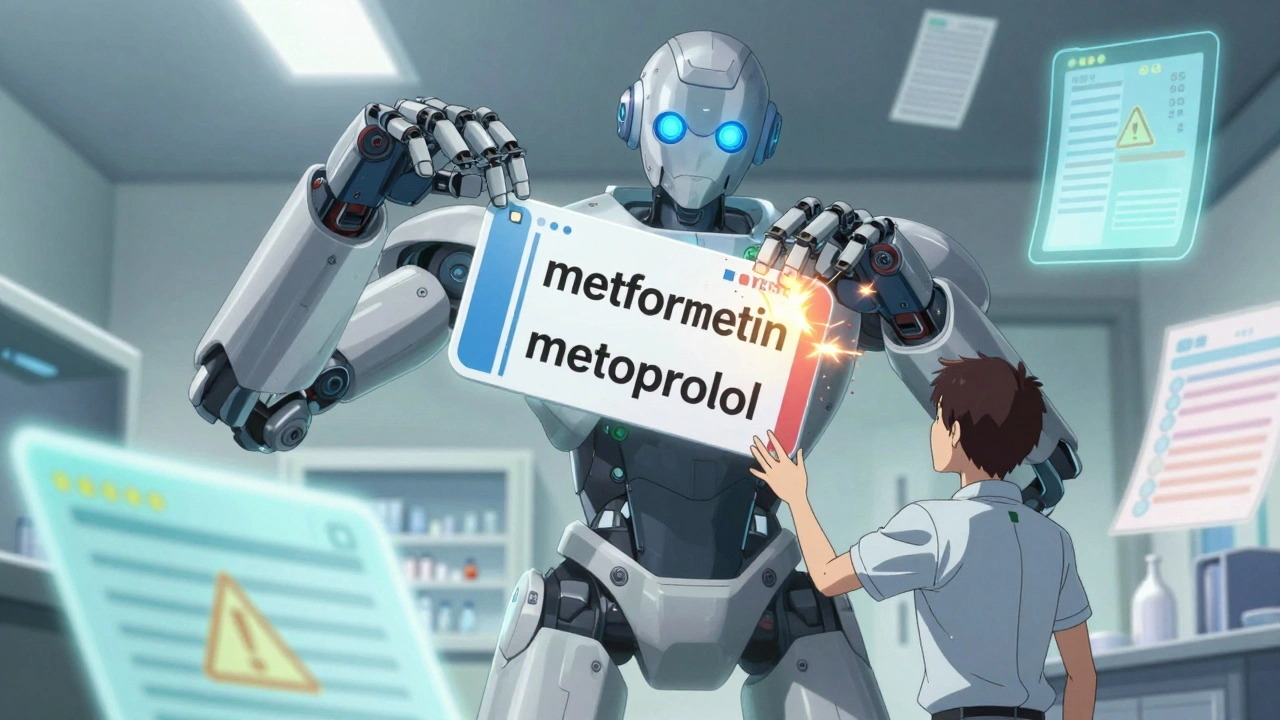
Imagine this: a patient gets a prescription for metformin, but the label says metoprolol. One letter. One typo. That’s not a small mistake-it’s a life-threatening error. In pharmacies across Scotland and beyond, labeling errors happen more often than you think. And when they do, the consequences aren’t just theoretical. They’re real. Patients get the wrong drug. They have adverse reactions. Sometimes, they die.
These aren’t just computer glitches or rare accidents. According to the UK’s National Patient Safety Agency, medication labeling errors contribute to over 250,000 preventable incidents annually in the UK alone. Most of these come from simple mistakes: misread handwriting, incorrect barcode scans, mismatched batch numbers, or labels printed with the wrong drug name. And here’s the kicker-many of these errors go unnoticed until it’s too late.
What Counts as a Labeling Error?
A labeling error isn’t just when the name is wrong. It’s any mismatch between what the drug is supposed to be and what the label says. That includes:
- Wrong drug name (e.g., lisinopril labeled as losartan)
- Incorrect strength (e.g., 500mg instead of 5mg)
- Wrong dosage form (e.g., tablet labeled as capsule)
- Missing or incorrect expiration date
- Wrong patient name or prescription number
- Barcodes that don’t match the label
- Incorrect routing instructions (e.g., oral instead of IV)
These aren’t just clerical slip-ups. They’re systemic failures. A 2024 audit by the Royal Pharmaceutical Society found that 1 in 12 dispensed prescriptions in community pharmacies had at least one labeling inconsistency. Most of these were caught before reaching the patient-but not all.
How to Spot Labeling Errors Before They Reach the Patient
You don’t need a PhD to catch a labeling error. You just need to slow down and look closely. Here’s how:
- Compare the label to the original prescription. Don’t just glance. Read every word. Check the drug name, strength, quantity, and directions. If it’s handwritten, compare it to the electronic version if available.
- Verify the barcode. Scan it. If the system says it’s amoxicillin but the label says azithromycin, stop. Don’t dispense. Don’t assume it’s a scanner glitch.
- Check the look of the pill. If you’re dispensing tablets, compare the color, shape, and imprint to the manufacturer’s description. A 500mg metformin tablet is white, oval, and scored. If it’s blue and round, something’s wrong.
- Look for duplicate labels. Sometimes, old labels are partially peeled off, and a new one is stuck on top. That’s a red flag. Peel back gently-if there’s more than one label, investigate.
- Ask yourself: Does this make sense? Why is a 72-year-old with kidney disease getting a high-dose NSAID? Why is a child getting an adult-strength antibiotic? If the prescription doesn’t match the patient’s profile, question it.
These aren’t just best practices-they’re survival tactics. In one Aberdeen pharmacy, a technician noticed the label on a bottle of insulin said "100 units/mL" but the vial was labeled "U-500". That’s five times the concentration. If it had been dispensed, the patient could have gone into a fatal hypoglycemic coma. She caught it because she asked: "Why does this look different?"
How to Ask for Corrections Without Sounding Accusatory
When you find an error, you don’t want to blame someone. You want to fix it. The way you ask matters.
Instead of saying, "You messed up," say:
- "Can we double-check this label against the prescription? I’m seeing a mismatch on the strength."
- "I noticed the barcode doesn’t match what’s printed. Can we re-scan it?"
- "This looks like it might be a mix-up with another batch. Can we pull the original order record?"
Use "we" language. Make it a team effort. Most labeling errors happen because of rushed workflows, unclear instructions, or outdated templates-not because someone was careless.
One pharmacist in Dundee told me she started using a simple script: "I’ve got a question about this label-can we walk through it together?" She found that pharmacists and technicians were far more willing to admit mistakes when they weren’t put on the defensive.

What to Do When the Error Is Already in the System
What if the label was printed, dispensed, and the patient already left? You still have to act.
- Stop the error from spreading. If it’s a batch issue, quarantine all similar labels. Don’t wait for someone to tell you to.
- Notify the patient immediately. Call them. Don’t send a letter. Don’t wait. Say: "We found a mistake on your label. You were given the wrong medication. Please stop taking it and bring it back. We’ll replace it right away."
- Document everything. Record what the error was, how it was found, who was involved, and what was done to fix it. This isn’t just for compliance-it’s for learning.
- Report it. In Scotland, all serious medication errors must be reported to the Scottish Patient Safety Programme (SPSP). Even if the patient was fine, report it. That’s how systems improve.
One pharmacy in Inverness had a recurring issue with prednisolone being mislabeled as prednisone. After three near-misses, they implemented a new rule: every corticosteroid label must be verified by two people, and the word "PREDNISOLONE" must be printed in bold red letters. The error rate dropped to zero within two months.
How to Prevent Labeling Errors Before They Happen
Prevention is better than correction. Here’s what works:
- Use electronic prescribing. Handwritten scripts are the #1 source of labeling errors. If you’re still using paper, push for e-scripts. They cut labeling mistakes by 70%.
- Standardize label templates. Make sure every label has the same layout: drug name, strength, dosage form, directions, patient name, prescriber, date, and expiration. No variations.
- Train staff on common look-alike, sound-alike drugs. Lasix and Lantus. Zyrtec and Zoloft. Propranolol and Propafenone. These are the usual suspects. Make a list. Post it. Quiz staff quarterly.
- Implement a second-check system. For high-risk drugs-insulin, opioids, anticoagulants-require two people to verify the label before dispensing. It’s slow, but it saves lives.
- Use color coding. Red for high-alert meds. Yellow for narcotics. Green for antibiotics. Visual cues stick better than text.
A 2023 study in the British Journal of Clinical Pharmacology found that pharmacies using these five practices reduced labeling errors by 82% over 18 months. No fancy software. Just better habits.
When to Escalate: Beyond the Pharmacy
Some errors aren’t just mistakes-they’re signs of bigger problems.
If you see:
- Repeated errors from the same supplier
- Labels consistently printed with wrong fonts or missing fields
- Technicians saying, "We’ve always done it this way,"
Then it’s time to escalate. Talk to your manager. Contact the wholesaler. Report it to the Medicines and Healthcare products Regulatory Agency (MHRA). Don’t wait for someone to get hurt.
One pharmacy in Aberdeen stopped using a certain wholesaler after three batches of amiodarone had the wrong expiration date printed. They switched suppliers. The next batch? Perfectly labeled. No more issues.
Final Thought: Your Eyes Are the Best Tool
No algorithm, no barcode scanner, no automated system can replace a trained human who takes a moment to look. Technology helps-but it doesn’t replace vigilance.
Every time you pause before dispensing, every time you double-check, every time you ask a question-you’re not being slow. You’re being safe.
Medication labeling isn’t about paperwork. It’s about people. And the right label? It’s the difference between healing and harm.
What are the most common medication labeling errors?
The most common errors include wrong drug name (e.g., metformin vs. metoprolol), incorrect strength (500mg instead of 5mg), wrong dosage form (tablet vs. capsule), missing or incorrect expiration dates, mismatched patient names, and barcodes that don’t match the label. Look-alike, sound-alike drugs are especially risky.
How can I tell if a label is wrong if I’m not a pharmacist?
Even if you’re not a pharmacist, you can spot red flags. Check if the pill looks different from what you’ve taken before. Verify the name and strength match your prescription. If the directions say "take once daily" but you’ve always taken it twice, ask. Trust your instincts. If something feels off, question it.
What should I say if I find a labeling error?
Use calm, collaborative language: "Can we double-check this label against the prescription? I noticed the strength doesn’t match." Avoid blame. Focus on fixing the issue, not assigning fault. Most errors come from workflow problems, not negligence.
Can a barcode scanner catch all labeling errors?
No. A barcode scanner only checks if the barcode matches the system’s record. If the label was printed wrong but the barcode was generated from the same wrong data, the scanner won’t catch it. Always visually verify the label against the prescription-even if the barcode scans.
What should I do if a patient already took the wrong medication?
Contact the patient immediately by phone. Advise them to stop taking the medication. Offer a replacement. Document the error, report it to your local patient safety program (like SPSP in Scotland), and notify the prescriber. Never wait-delaying increases the risk of harm.
How can pharmacies prevent labeling errors long-term?
Use electronic prescribing, standardize label templates, train staff on look-alike/sound-alike drugs, implement a two-person verification for high-risk meds, and use color coding. Regular audits and a blame-free reporting culture also help. The most effective pharmacies combine technology with human vigilance.


Michelle Edwards
December 11, 2025 AT 11:47Just wanted to say thank you for writing this. I’m a nurse in Ohio, and I’ve seen too many close calls with meds. The part about the insulin? Chills. We don’t need fancy tech-we need people who pause. Seriously. Slow down. Breathe. It’s not slow, it’s safe.
Keep doing the work.
Neelam Kumari
December 13, 2025 AT 11:21Wow. Another bleeding-heart liberal pamphlet on how ‘we’re all just tired humans’ and errors are ‘systemic.’ Newsflash: if your pharmacist can’t read a prescription or scan a barcode, they shouldn’t be handling drugs. Stop coddling incompetence. Train them. Or fire them. Simple.
Also, why is this even a thing in 2024? We have AI now.
Raj Rsvpraj
December 15, 2025 AT 03:58Of course this is happening-because Western countries are too soft to enforce standards. In India, we train pharmacists for three years before they touch a prescription. No one says ‘can we double-check?’-we just DO it right. Your ‘team effort’ nonsense is why your system is collapsing. Discipline. Training. Accountability. That’s what saves lives. Not ‘color coding’ or ‘we language.’
Stop romanticizing failure.
Kaitlynn nail
December 16, 2025 AT 10:10It’s funny how we treat meds like they’re magic beans. You take the pill, you get better. But no one ever checks the damn label. I mean… really? You don’t read the bottle? You just swallow?
Also, why is this even a post? Isn’t this basic? Like… don’t drink poison. Basic.
Aileen Ferris
December 17, 2025 AT 20:27labeling errors? pfft. i bet its all a big pharma plot to sell more drugs. like… what if the wrong med is actually the RIGHT one? maybe metformin is just a cover for the real treatment? who even wrote this? some pharma rep in a hoodie?
Rebecca Dong
December 19, 2025 AT 15:13EVERYONE KNOWS this is just the tip of the iceberg. They’re replacing pharmacists with robots. And the robots? They’re controlled by a secret AI that’s slowly changing all your meds to make you dependent. That’s why the barcodes don’t match. That’s why the pills look different. I saw it on a documentary. They call it ‘The Label Protocol.’
They’re watching. And they’re changing your insulin.
Don’t trust the label. Trust your gut. And burn your pill bottle.
They’re coming for your thyroid next.
Sarah Clifford
December 21, 2025 AT 07:26Y’all are overcomplicating this. If the pill looks weird, don’t take it. If the name doesn’t match your last script, ask. If you’re scared, call your doctor. Done.
Stop making it a whole thing. It’s just a pill. Don’t be dramatic.
Regan Mears
December 22, 2025 AT 03:38I’ve worked in three different pharmacies across three states. The one thing that always worked? The two-person check. Always. Even if you’re in a rush. Even if the system says it’s fine. Even if the barcode scans. You stop. You look. You talk. You confirm.
And when someone says, ‘We’ve always done it this way’-you don’t argue. You just say, ‘Let’s try this new way. For the patient.’
It’s not about blame. It’s about care. And if your pharmacy won’t do it? Find one that will.
Queenie Chan
December 23, 2025 AT 17:23What’s wild is how the most dangerous errors aren’t the ones that scream-they’re the ones that whisper. The label that’s *almost* right. The pill that’s *almost* the same color. The dose that’s *almost* acceptable. We’re trained to hunt for the obvious, but the quiet ones? The ones that slip through because ‘everyone knows what it’s supposed to be’? Those are the killers.
And honestly? The fact that we need a whole guide just to read a label… that’s the real tragedy. Not the typo. The fact that we’ve let it get this far.