
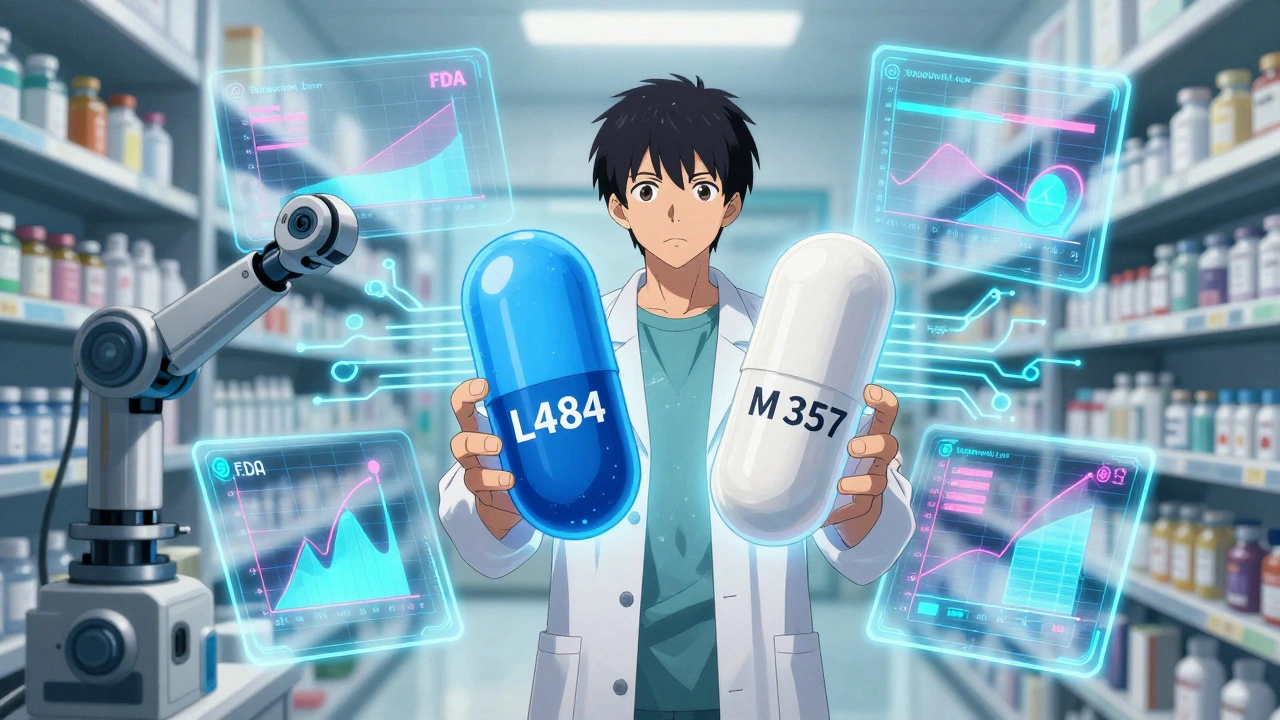
When you pick up your prescription, you might notice something strange: the pill looks different. Maybe it’s a different color, shape, or has new letters stamped on it. You might panic-did the pharmacy give you the wrong medicine? Or worse, is this fake? The truth is, this is normal. It’s not a mistake. It’s just a different generic manufacturer.
Generic drugs make up over 90% of all prescriptions filled in the U.S. And yet, most people don’t know how they’re made, who makes them, or why they look nothing like the brand-name version they remember. The good news? They work the same. The tricky part? Not all generics are created equal when it comes to appearance-and that’s where confusion starts.
Why Do Generic Pills Look Different?
Generic drugs must contain the same active ingredient, strength, and dosage form as the brand-name version. That’s the law. But the FDA doesn’t require them to look the same. Why? Because the brand-name company owns the trademark on the pill’s color, shape, and imprint. If a generic looked identical, it would be copying the brand’s design-and that’s illegal.
So manufacturers make changes. A blue oval pill might become a white capsule. A scored tablet might turn into a round one without a line. Imprints change too: instead of "L484," you might see "M 357." These differences aren’t random. They’re required by the 1970 Federal Food, Drug, and Cosmetic Act amendments, which mandate unique imprints so pills can be identified in emergencies.
A 2020 study in Nature Scientific Reports found that 78% of generic versions differ in color, 65% in shape, and 42% in size compared to the brand. That’s not a flaw. It’s the system working as designed.
Do Different Looks Mean Different Effectiveness?
No. Not if the generic is FDA-approved.
The FDA requires all generics to prove they’re bioequivalent to the brand. That means the body absorbs the drug at nearly the same rate and amount. The standard is a 90% confidence interval of 80-125% for two key measurements: Cmax (peak concentration) and AUC (total exposure). For most drugs, that’s a difference of just 3.5% on average-less than the variation you’d see between two batches of the same brand-name pill.
Even for tricky drugs like warfarin or levothyroxine, where small changes matter, the FDA tightens the bioequivalence range to 90-111%. A landmark FDA study of over 2,000 bioequivalence trials showed no meaningful difference in how patients responded to generics versus brands.
Dr. Janet Woodcock, former top FDA official, put it simply: "The FDA’s bioequivalence standards ensure that generic drugs perform in the same manner as their brand-name counterparts in 99.9% of cases."
So if the pill looks different but works the same, why do people worry?
Why People Think Generics Don’t Work
It’s not science-it’s psychology.
Patients often associate how a pill looks with how it feels. If your antidepressant used to be a green capsule and now it’s a white tablet, your brain might think, "This isn’t the same." That’s not irrational-it’s human. A 2022 Consumer Reports survey found 41% of patients felt uneasy when their pill changed appearance. Nearly 20% said they’d question their pharmacist about it.
Some cases are real. For drugs with a narrow therapeutic index-like lithium, phenytoin, or levothyroxine-switching between generic manufacturers can sometimes cause small changes in blood levels. Not because the drug is bad, but because inactive ingredients (like fillers or coatings) can affect how fast the pill dissolves. In rare cases, this has led to side effects or reduced effectiveness.
One well-known case involved Lamotrigine. After a formulation change in 2012, some patients reported seizures returning. The issue wasn’t the active ingredient-it was how the new coating affected absorption. That’s why doctors often recommend staying with the same generic manufacturer for these drugs.
The American Medical Association’s 2023 policy says: "For narrow therapeutic index drugs, maintain the same generic manufacturer unless medically necessary."

Who Makes Generic Pills?
Not all generic manufacturers are the same. Some are huge global players. Others are small, regional companies.
The top three in the U.S.:
- Teva-World’s largest generic maker. Makes over 1,000 generic drugs. Known for consistency.
- Viatris (formed from Mylan + Upjohn)-Strong in complex generics like inhalers and injectables.
- Sandoz (Novartis spin-off)-Focuses on high-quality, high-volume generics.
Smaller players like Hikma, Dr. Reddy’s, and Apotex also make quality products. But here’s the catch: first-to-market generics often get 60-70% of sales. But as more companies enter, prices drop-and sometimes quality control slips.
Price drops fast. With three competitors, prices fall about 20%. With ten or more, they can drop 70-80% within three years. That’s great for consumers. But it also means some manufacturers cut corners on inactive ingredients to save money.
That’s why knowing your manufacturer matters-for consistency, not because one is "better."
How to Identify Your Generic Pill
When your pill changes, don’t guess. Don’t assume it’s wrong. Use tools to confirm.
Here’s how:
- Check the imprint-Look for letters or numbers on the pill. That’s your key identifier.
- Use Drugs.com Pill Identifier-Enter color, shape, and imprint. It matches over 12 million pills. Used by 12.7 million people monthly.
- Ask your pharmacist for the NDC code-Every pill has a National Drug Code. It’s a 10-digit number on the bottle. Look it up in the FDA’s NDC Directory to find the exact manufacturer.
- Check Drugs@FDA-Search by drug name. You’ll see all approved versions, including which company makes what.
For example: If you take Metoprolol Tartrate 50 mg, and your pill changes from a white oval with "M 357" to a blue round one with "TEVA 476," both are legitimate. One is made by Teva. The other by Mylan. Same drug. Same effect. Different look.

What to Do When Your Pill Changes
Here’s a simple checklist:
- Don’t stop taking it. The drug is still safe and effective.
- Check the imprint and color using Drugs.com or ask your pharmacist.
- If you’re on a narrow therapeutic index drug (like warfarin, thyroid meds, or seizure drugs), ask your doctor if you should stay with the same manufacturer.
- Write down your pill’s appearance-color, shape, imprint-so you can spot changes.
- If you feel different-dizzy, shaky, more anxious, or less effective-tell your doctor. It might be unrelated, but it’s worth checking.
Pharmacists are trained to explain this. Don’t be embarrassed to ask: "Is this the same medicine?" Most will show you the NDC and confirm it’s correct.
When to Stick With One Manufacturer
For most people, switching between generics is fine. But for some, it’s not worth the risk.
Stick with the same manufacturer if you take:
- Warfarin (Coumadin)
- Levothyroxine (Synthroid)
- Lithium
- Phenytoin (Dilantin)
- Carbamazepine (Tegretol)
- Lamotrigine (Lamictal)
These are drugs where even a small change in blood level can cause problems. The FDA recommends "dispense as written" (DAW-1) for these. That means your prescription should say "Do Not Substitute." If it doesn’t, ask your doctor to add it.
Many insurance plans push for the cheapest generic. But if you’ve been stable on one brand, ask for a prior authorization to keep it. It’s your right.
Bottom Line: Appearance Doesn’t Equal Effectiveness
Generic drugs save patients an average of $265 per month compared to brand names. That’s real money. And they work.
Pill appearance changes are normal. They’re not a sign of inferior quality. They’re just the result of competition, regulation, and trademark law.
But you’re not powerless. Know how to identify your pill. Know your manufacturer. Know when to ask for consistency. And remember: if you feel different after a switch, speak up. Your body knows. You just need to listen-and verify.
Are generic drugs as effective as brand-name drugs?
Yes, for the vast majority of medications. The FDA requires generics to prove they’re bioequivalent to the brand-meaning they deliver the same amount of active ingredient into your bloodstream at the same rate. Studies show average differences in absorption are just 3.5%, similar to batch-to-batch variation in brand-name drugs. In over 99% of cases, generics work just as well.
Why do generic pills look different from brand-name ones?
Brand-name companies hold trademarks on the color, shape, and imprint of their pills. To avoid infringement, generic manufacturers must make their versions look different. This is required by law, not a quality issue. The active ingredient remains identical.
Can changing generic manufacturers affect how a drug works?
For most drugs, no. But for narrow therapeutic index drugs-like warfarin, levothyroxine, or lithium-small differences in how the pill dissolves can affect blood levels. In rare cases, switching manufacturers has led to side effects or reduced effectiveness. If you take one of these drugs, it’s safest to stick with the same manufacturer unless your doctor advises otherwise.
How can I tell if my generic pill is the right one?
Use the imprint (letters/numbers), color, and shape to look up your pill on Drugs.com’s Pill Identifier. You can also ask your pharmacist for the National Drug Code (NDC) on your bottle and check it in the FDA’s NDC Directory. Both tools confirm the manufacturer and ensure you’re getting the correct medication.
Should I always use the same generic manufacturer?
For most people, switching is fine. But if you take a narrow therapeutic index drug, it’s better to stick with one manufacturer to avoid small changes in how your body absorbs the medication. Ask your doctor to write "dispense as written" (DAW-1) on your prescription to prevent automatic substitution.
Are cheaper generics less safe?
Not necessarily. All FDA-approved generics meet the same safety and quality standards. But as competition increases and prices drop, some manufacturers may use lower-cost inactive ingredients. While this doesn’t make the drug unsafe, it can affect how quickly it dissolves. That’s why consistency matters-especially for critical medications. Always verify your pill’s appearance and manufacturer.
If you’ve ever stared at a pill and wondered, "Is this the same?"-you’re not alone. The system is designed to save money, not confuse you. But you have the tools to understand it. Know your pill. Know your drug. And never be afraid to ask.





Willie Onst
December 13, 2025 AT 02:24Man, I used to freak out every time my pill changed color. Thought I was getting fake stuff or the pharmacy messed up. Then I learned about the FDA rules and started checking imprints on Drugs.com. Now I just shrug and say, 'cool, another version.' Saved me a ton of stress-and cash. 🙌
John Fred
December 13, 2025 AT 10:11Yessss! This is why I always screenshot my pill before I fill it. 📸 Bioequivalence = same active ingredient, same effect. The rest? Just branding. Generic = 80% cheaper, 100% legit (if FDA-approved). If your doc says 'dispense as written' for levothyroxine? DO IT. Otherwise, switch freely. 💪💊
Harriet Wollaston
December 13, 2025 AT 21:47I’m a nurse, and I can’t tell you how many patients panic when their pill looks different. I keep a printed guide in my bag with common generics and their appearances. Last week, a 72-year-old woman cried because her 'blue pill' turned white. We looked it up together-same drug, same dose. She hugged me. It’s not just medicine-it’s comfort. 🫂
kevin moranga
December 14, 2025 AT 15:37Look, I get it. You see a pill that doesn’t look like the one from last month and your brain goes full alarm mode. But here’s the thing-your body doesn’t care what color it is. It cares about the active ingredient, the dissolution rate, and whether the bioequivalence is within 80–125%. That’s it. The rest is psychological noise. I’ve been on the same generic for 12 years. Switched manufacturers 7 times. Still stable. Still alive. Still saving $200/month. Don’t let aesthetics scare you. The science is on your side. 🧪
Michael Gardner
December 15, 2025 AT 01:34Everyone’s acting like this is some groundbreaking revelation. Newsflash: generics have looked different since the 80s. The real issue? Big Pharma spends millions convincing people brand = better. Meanwhile, your insurance company forces switches to cut costs. So yes, the pill looks different-but it’s not because of some conspiracy. It’s because corporations are greedy and you’re being manipulated. And now you’re just grateful they didn’t raise the price? 🤡
Ronan Lansbury
December 15, 2025 AT 12:09Let’s be honest. The FDA’s 'bioequivalence' standards are laughable. 80–125%? That’s a 45% window. I’ve read the raw data-some generics have 15% variation in Cmax. And who’s testing them? Underpaid contractors in India or China. The 'same active ingredient' claim is technically true-but the excipients? Unregulated. You think your thyroid med isn’t affected by a different starch filler? Please. This is pharmaceutical theater. You’re being sold a placebo with a label that says 'FDA approved.'
Himmat Singh
December 16, 2025 AT 02:22It is imperative to note that the regulatory framework governing generic pharmaceuticals in the United States is predicated upon the assumption of physiological homogeneity across populations, which is an empirically unsound premise. Genetic polymorphisms in cytochrome P450 enzymes, particularly among South Asian and African-descended populations, can significantly alter pharmacokinetic profiles. Therefore, blanket assertions of bioequivalence are methodologically flawed. The FDA’s statistical thresholds do not account for inter-individual variability in drug metabolism. One must exercise extreme caution.
Lara Tobin
December 17, 2025 AT 02:41I switched generics for my anxiety med last year and felt like I was losing my mind for two weeks. Couldn’t sleep, felt jittery… I thought I was going crazy. Then I realized it was the new pill. I asked my pharmacist for the old one and everything went back to normal. I didn’t know I could ask. I’m so glad I did. You’re not crazy if you feel different. It’s real. 🤍
Alvin Montanez
December 17, 2025 AT 13:06People are so naive. You think this is about 'saving money'? No. It’s about corporate control. The same companies that make brand-name drugs also own the generics. Teva? Owned by the same investors as the original brand. Viatris? A merger between two giants who want you to believe they’re competing. The FDA is a revolving door. The 'different appearance' excuse? A legal loophole to keep you hooked on the illusion of choice. You’re not getting cheaper medicine-you’re getting the same product with a different label. And you’re thanking them for it. Pathetic.
Shelby Ume
December 18, 2025 AT 15:56As someone who’s helped elderly patients navigate this for over 15 years, I can’t stress this enough: write down your pill’s appearance. Color. Shape. Letters. Take a photo. Keep it in your wallet. When you get a new bottle, compare. If it’s different, ask for the NDC code. Pharmacists love this question-it means you’re engaged. And if you’re on warfarin or levothyroxine? Don’t let your insurance switch you. Advocate. Ask for DAW-1. You’re not being difficult-you’re being smart. And you deserve to feel safe with your meds. 💙