
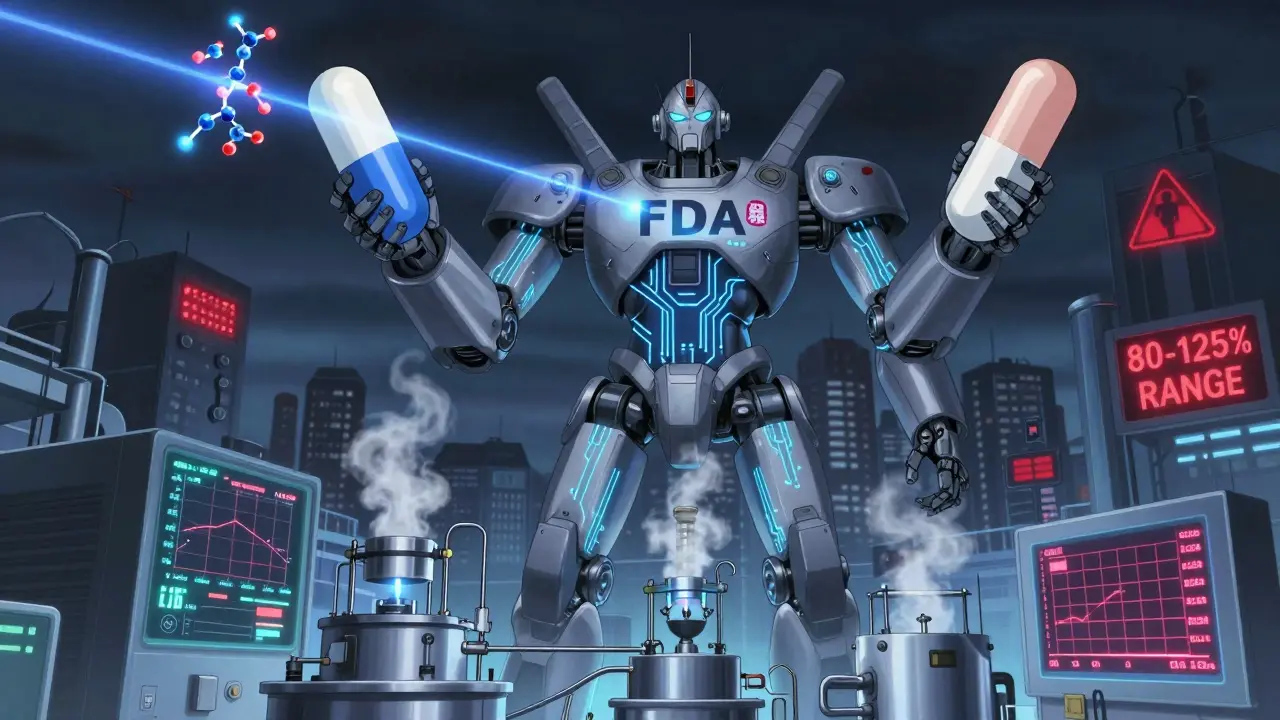
Every day, millions of people in the U.S. take generic drugs instead of brand-name versions. They do it because generics cost less-often 80% to 85% less. But a big question lingers: Do they really work the same? The answer isn’t just yes-it’s backed by science, strict rules, and decades of oversight from the U.S. Food and Drug Administration (FDA).
The FDA’s Hidden System for Generic Drugs
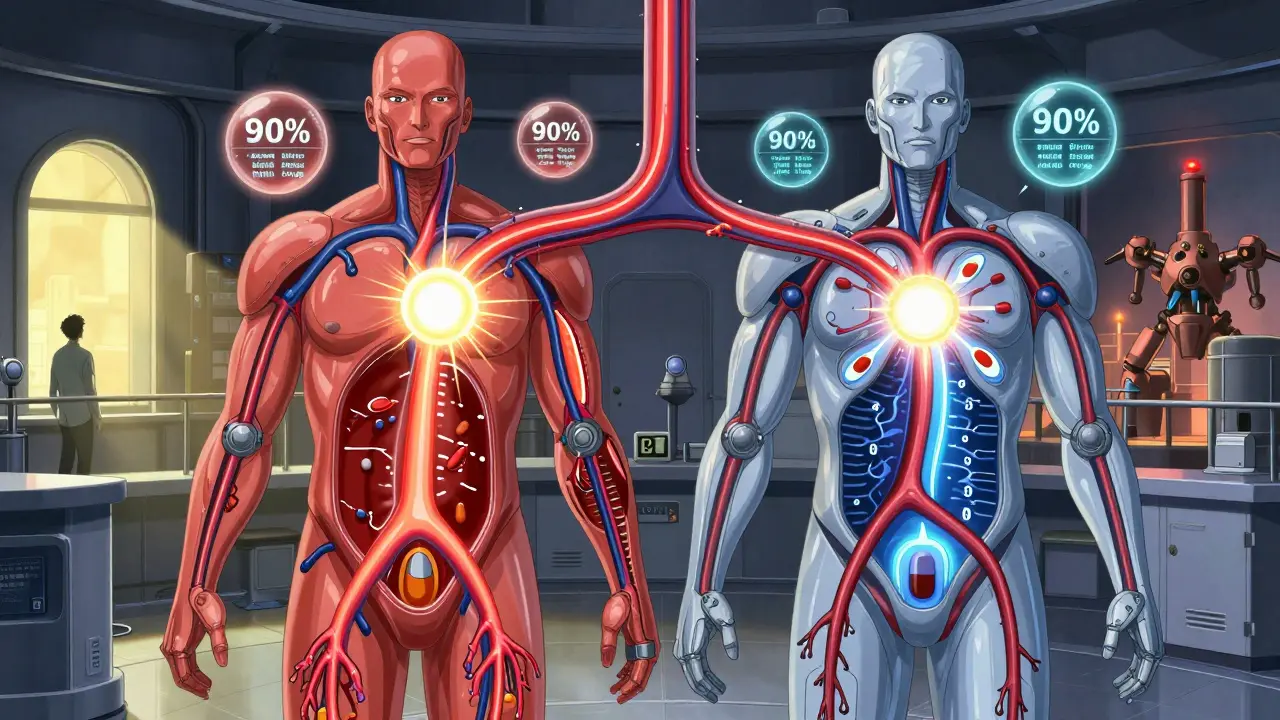
The FDA doesn’t treat generic drugs like second-rate copies. Instead, it has a detailed, science-driven system called the Abbreviated New Drug Application (ANDA). This process was created in 1984 by the Hatch-Waxman Act to let generic companies bring affordable versions of brand-name drugs to market without repeating every single clinical trial. The key? Prove the generic is bioequivalent to the original.That means the generic must deliver the same amount of active ingredient into your bloodstream at the same speed as the brand. Not close. Not almost. Exactly within a narrow range. For most drugs, the FDA requires that the rate and extent of absorption fall between 80% and 125% of the brand’s levels. This isn’t a guess-it’s measured using blood tests in healthy volunteers, usually 24 to 36 people. The results are analyzed statistically, and the 90% confidence interval for the key measurements (AUC and Cmax) must stay inside that 80-125% window.
What’s Inside the Pill? Identical Active Ingredients
The active ingredient-the part that actually treats your condition-must be chemically identical. If the brand drug has 20 mg of atorvastatin, the generic must have exactly 20 mg, with a tolerance of only ±5%. The FDA checks this with lab tests on multiple batches. No exceptions.And it’s not just the active ingredient. The dosage form matters too. If the brand is a delayed-release tablet, the generic must be too. If the brand is a liquid suspension, the generic can’t be a capsule. The route of administration must match: oral, injectable, topical, inhaled-everything has to be the same.
Even the strength has to be identical. A 500 mg metformin tablet from a generic maker must deliver the same amount of drug as the 500 mg version from the original brand. The FDA tests for content uniformity: each tablet in a batch must contain between 85% and 115% of the labeled amount. If one tablet is too weak or too strong, the whole batch gets rejected.
Manufacturing Isn’t a Side Note-It’s the Core
You might think generics are made in cheap, sketchy factories. That’s a myth. The FDA inspects every manufacturing site-whether it’s in the U.S., India, or China-before approving a generic. These sites must follow Current Good Manufacturing Practices (cGMP), the same rules brand-name companies follow.That means:
- Equipment is cleaned and validated to prevent cross-contamination
- Raw materials are tested for purity before use
- Every batch is tested for identity, strength, and stability
- Production records are kept for years
In 2022, about 21% of rejections (called Complete Response Letters) were due to manufacturing issues. That’s not because generics are poorly made-it’s because the FDA holds them to the same exacting standards as the original.
What About the Other Ingredients?
The inactive ingredients-like fillers, dyes, or preservatives-can be different. That’s why some people say a generic “feels different.” But these differences are tightly controlled. The FDA maintains an Inactive Ingredient Database that lists safe limits for over 500 excipients across 80 different ways drugs can be given (oral, injectable, eye drops, etc.).If a generic uses a new excipient, the manufacturer must prove it’s safe at the dose used. For example, if a brand uses a specific dye that’s been used safely for decades, the generic can use a different dye-but only if it’s been shown not to cause allergic reactions or affect absorption.
The Approval Process: Faster, But No Less Rigorous
While a brand-name drug takes 10-15 years and over $2 billion to develop, a generic takes 3-5 years and $1.5 million to $3 million. That’s because the generic company doesn’t have to prove the drug works. The FDA already did that for the brand.The ANDA process has clear stages:
- Filing Review (60 days): The FDA checks if the application is complete. In 2022, 35% of submissions were refused because of missing or flawed data.
- Substantive Review: Teams of chemists, pharmacologists, and statisticians examine every page of data-often 30,000 to 50,000 pages total.
- Facility Inspection: The factory is visited. If it fails, approval is delayed.
- Approval or Rejection: If everything checks out, the generic gets the green light.
In 2022, the FDA approved 777 ANDAs. That’s nearly two per day. The goal? To get a standard application reviewed in 10 months. In 2022, they hit 91.3% of that target.
What About Drugs That Are Hard to Copy?
Some drugs are tricky. Think inhalers, creams, injectable emulsions, or complex oral suspensions. These are called “complex generics.” They’re not just pills you swallow. Their physical structure affects how they work.For these, the FDA requires extra testing. In 2022, 45% of rejections for complex generics were because manufacturers couldn’t prove equivalence. The FDA responded by releasing 27 new guidance documents in 2023-each one telling companies exactly how to test their product.
For example, a generic EpiPen must deliver the same amount of epinephrine at the same speed and pressure as the brand. That’s not easy. It took years for the first generic EpiPen to get approved-and even then, it required dozens of bioequivalence studies.
Narrow Therapeutic Index Drugs: Extra Care
Some drugs have a very narrow window between working and causing harm. Think warfarin (a blood thinner), levothyroxine (for thyroid), or phenytoin (for seizures). A tiny difference in blood level can lead to a clot or a seizure.For these, the FDA tightened the bioequivalence range to 90-111% instead of 80-125%. They also maintain a public list of these drugs so doctors and pharmacists know which ones need extra caution. Even then, studies show most patients do just fine on generics.
A 2023 IQVIA analysis of 15 million patients found no difference in outcomes between brand and generic versions of common drugs like atorvastatin and metformin. In fact, adherence was 3.2% higher with generics-likely because patients could afford to keep taking them.
Real-World Evidence: What Patients and Pharmacists Say
Some patients report feeling different on a generic. A 2021 survey found 37% of independent pharmacists heard concerns from patients, especially with neurological or chronic conditions. But when the FDA looks at the data, these reports rarely match clinical outcomes.The FDA’s Adverse Event Reporting System shows generic drugs have the same rate of side effects as brand-name drugs-1.7 per million prescriptions versus 1.6. On Reddit’s r/pharmacy, 82% of pharmacists said they’ve seen no meaningful difference in real-world use.
Still, the FDA listens. In 2020, they held a public meeting with patients to hear concerns. They found that while 89% trusted FDA-approved generics, 41% had switched between brand and generic at least once. Only 12% reported feeling the generic didn’t work as well-but objective tests showed no real difference.
Why This Matters: Cost, Access, and Lives
Generic drugs save the U.S. healthcare system $313 billion a year. They’re used in 90% of all prescriptions filled. Without them, millions of people couldn’t afford their meds. A diabetic might skip insulin. A heart patient might stop taking their blood pressure pill.The FDA’s system makes sure those generics aren’t just cheap-they’re safe, effective, and reliable. It’s not perfect. Complex drugs are still hard to copy. Some patients still feel uneasy. But the science is clear: FDA-approved generics work the same as brands.
The next time you pick up a generic prescription, remember: it didn’t get approved by accident. It passed a gauntlet of tests, inspections, and reviews designed to make sure it’s just as good as the brand-without the high price tag.



jeremy carroll
December 15, 2025 AT 05:13man i used to be scared of generics til i started filling my own scripts. my grandma’s blood pressure med? generic. my anxiety stuff? generic. never had an issue. saved me like 80 bucks a month. the fda ain’t playin’ around.
Natalie Koeber
December 17, 2025 AT 02:34oh sure, the fda says it’s all good. but have you ever seen the factory tours? they outsource to india where the water’s dirty and the inspectors get paid in chai. the ‘bioequivalence’ data? cooked. they just need to pass the math, not the real world. i’ve seen people crash on generics. they just don’t report it.
Rulich Pretorius
December 17, 2025 AT 11:20the real miracle here isn’t that generics work-it’s that a bureaucratic system designed in the 1980s still holds up under the weight of global supply chains, profit motives, and public distrust. the science is sound, yes-but the trust is fragile. what we’re seeing isn’t just regulatory rigor. it’s a quiet social contract: we’ll keep you alive cheaply, if you’ll stop asking why.
Dwayne hiers
December 19, 2025 AT 08:30bioequivalence thresholds are statistically derived from crossover studies with n=24-36 healthy volunteers under fasting conditions. the 90% CI for AUC and Cmax must fall within 80–125% for most drugs, per 21 CFR 320.23. for NTIDs, the tighter 90–111% range applies per FDA guidance from 2012. the ANDA submission requires full dissolution profiling across pH ranges, not just single-point assays. most critics don’t understand the depth of the analytical validation required.
Jonny Moran
December 21, 2025 AT 00:22for anyone scared of generics: you’re not alone. but you’re also not wrong to feel uneasy-when your health’s on the line, it’s natural. the good news? the system works. i’ve seen patients on warfarin switch back and forth for years. their inr stays stable. the difference isn’t in the pill-it’s in the fear. give it time. your body doesn’t care who made it.
Alexis Wright
December 21, 2025 AT 06:27let’s be real-this is corporate propaganda dressed as science. the fda approves generics so pharma can keep raising brand prices. they don’t want you to know that 80% of generic manufacturers are owned by the same conglomerates that make the brand names. it’s a shell game. the ‘identical active ingredient’? sure. but the excipients? loaded with microplastics and fillers banned in europe. you think they’d let you swallow that if you paid full price?
Rich Robertson
December 22, 2025 AT 16:37in south africa, we call them ‘copy drugs’-and we trust them more than our own local pharmacies. here in the u.s., you’ve got this weird mix of privilege and paranoia. people will pay $400 for a brand-name inhaler but freak out over a $12 generic. the science doesn’t care where you’re from. your fear? that’s cultural.
Wade Mercer
December 22, 2025 AT 17:50i’ve read the entire fda guidance on andas. i’ve cross-referenced the inactive ingredient database. i’ve reviewed the 2022 rejection logs. and yet-i still won’t take a generic for my thyroid. not because it’s unsafe. because i’ve read too much. and sometimes, knowing too much is worse than not knowing at all.
Daniel Thompson
December 24, 2025 AT 13:17you know what’s worse than a bad generic? a pharmacist who doesn’t tell you they switched your med. i got prescribed levothyroxine. got a different bottle. no warning. felt like crap for two weeks. the fda’s rules are fine-but the system doesn’t protect you from human error. you’re on your own unless you ask.
Daniel Wevik
December 26, 2025 AT 01:59the fact that the fda approved 777 andas last year-nearly two per day-is a triumph of public health engineering. this isn’t just chemistry. it’s logistics, global oversight, statistical rigor, and manufacturing integrity on a scale no private company could replicate. we take this for granted. but if this system collapsed tomorrow, millions would die. don’t underestimate the quiet heroism of a regulated pill.
Sinéad Griffin
December 26, 2025 AT 07:25USA > EVERYONE ELSE 🇺🇸🔥 generics are american innovation. we made the rules. we enforce them. other countries copy our system. don’t let those fake news sites scare you. if it’s approved by the fda, it’s safe. period. 🇺🇸💪
Thomas Anderson
December 28, 2025 AT 04:40simple truth: if the pill looks right, works right, and doesn’t cost a fortune, why overthink it? my knee pain med? generic. my kid’s antibiotics? generic. i’ve never had a problem. the fda’s got your back. trust the process.